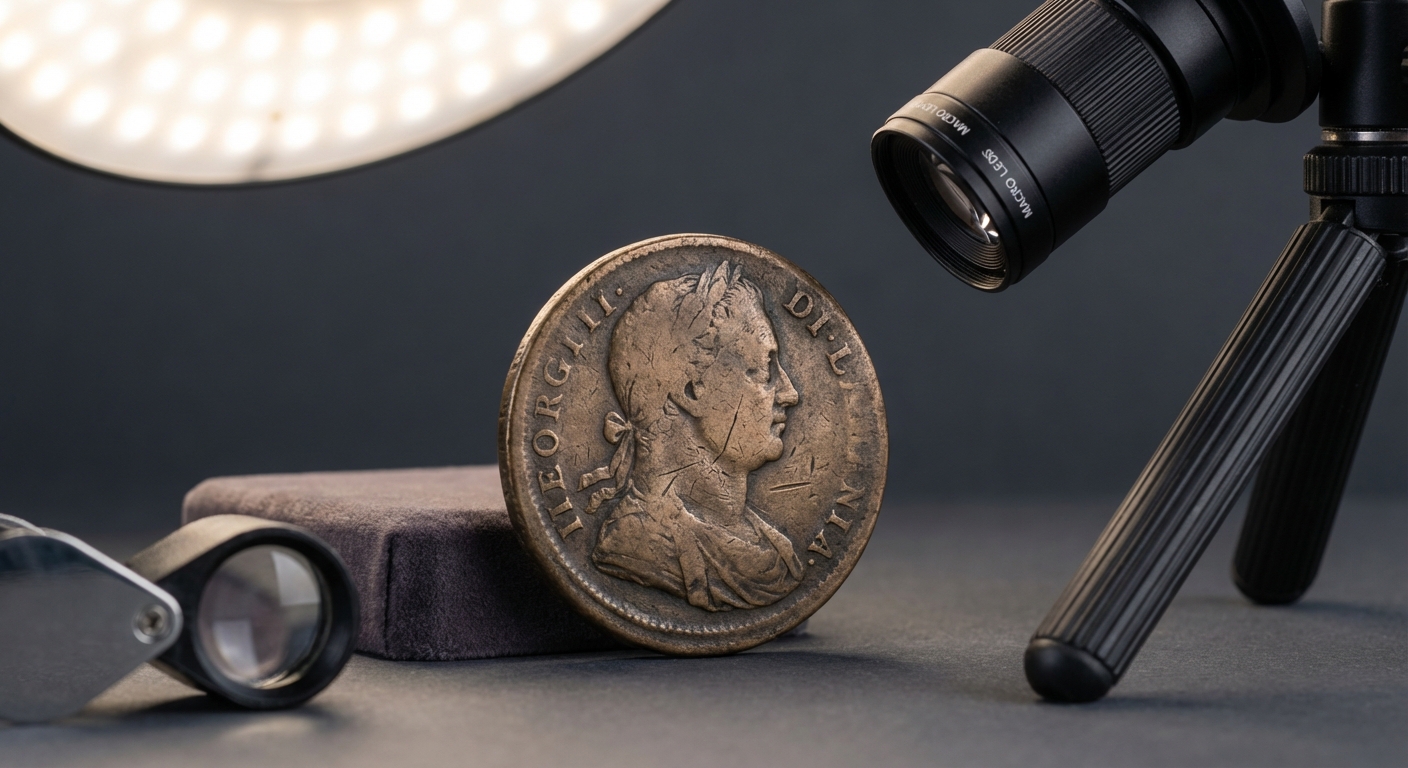
For numismatists and serious collectors, a coin’s story is etched into its surface, from the fine flow lines that create luster to the minute die defects that define rarity. Macro photography is not just a way to take a pretty picture; it is an indispensable tool for accurate grading, authentication, and creating a professional numismatic inventory. Capturing true detail and texture requires moving beyond a simple smartphone snap and adopting a methodical, expert approach that reveals a coin’s true condition. This guide walks you through the fundamentals of professional-grade coin macro photography.
Fundamentals of High-Detail Coin Photography
To accurately capture a coin’s surface, you must first master the essential terminology and equipment. The most critical aspect is achieving a magnification level that shows the coin at life size or greater, which is the domain of macro photography. A macro lens, ideally one that can achieve a 1:1 magnification ratio, is the cornerstone of this process, allowing you to focus extremely close to the subject . (legacy-coins.com)
Key Equipment for Coin Imaging
- Camera Body: A Digital SLR (DSLR) or mirrorless camera is recommended over a smartphone for maximum control over aperture, focus, and lighting, although modern smartphones with macro attachments can be surprisingly effective for beginners . (coingraderai.com)
- Macro Lens: A lens with a focal length between 35mm and 75mm (for a crop sensor) or 50mm and 100mm (for a full-frame sensor) is often ideal, as it allows a reasonable working distance from the coin . (thesilverforum.com)
- Stability: A sturdy tripod or, preferably, a copy stand is essential to eliminate camera shake, which is amplified at macro distances, guaranteeing crystal-clear focus and enabling precise alignment . (coinimaging.com)
- Lighting: Diffused light sources, such as softboxes or LED panel lights, are vital for minimizing harsh glare and reflections, which are common issues with metallic, reflective surfaces . (coinpeople.com)
Capturing Texture and Luster with Controlled Lighting
For numismatists, the difference between an average photograph and an exceptional one lies in the accurate portrayal of the coin’s texture, relief, and luster. Luster refers to the ‘cartwheel’ effect of light rotating across the coin’s surface, which is crucial for determining a coin’s grade .
To highlight the intricate texture—such as flow lines, die scratches, or slight wear—a technique called side lighting is paramount. Positioning one or two soft light sources to the side of the coin, often at a low angle (around 30 to 45 degrees), will cast slight shadows that dramatically emphasize the surface topography and relief, making every ridge and mark stand out . (blogspot.com) Conversely, if you want a flatter, more even representation of color and overall detail, lighting that is at a higher angle (closer to 90 degrees) or is diffused from multiple sources is preferable . (ngccoin.com)
For proof and proof-like coins, or for maximum professional quality, axial lighting is the preferred method by some professional coin photographers . (graphiquedujour.com) This advanced setup uses a sheet of glass or acrylic placed at a 45-degree angle to reflect a light source straight down onto the coin, making the light appear to come directly through the lens. This technique minimizes the camera’s shadow and provides a super-even, subtle illumination, which is ideal for accurately showing luster and preventing harsh reflections on mirrored fields .
Practical Step-by-Step for Optimal Coin Macro Photography
- Stabilize Your Setup: Mount your camera on a sturdy tripod or copy stand, pointing directly down at the coin. For maximum sharpness across the entire coin, ensure the camera sensor’s plane of focus is perfectly parallel to the coin’s surface . (adaptalux.com)
- Choose Your Aperture: Since macro photography results in a very shallow depth of field, select a high aperture number (small opening), such as f/8 to f/16, to maximize the depth of field and keep the entire coin in focus . Use Aperture Priority mode ("A" or "Av") to control this setting .
- Set the White Balance: Do not rely on Auto White Balance (AWB). Use a custom white balance setting with a grey card or manually set a daylight preset (5000K-6500K) to ensure accurate color representation, preventing an unrealistic color cast from your lights . (wikihow.com)
- Focus Precisely: Switch to Manual Focus. Use the camera’s Live View feature to zoom in digitally (10x or more) on a critical detail, such as the highest point of relief, and manually adjust the focus ring until it is tack-sharp. Alternatively, employ focus stacking, where multiple images at slightly different focus points are merged in post-processing to achieve total sharpness from front to back . (coincollecting.com)
- Adjust Lighting and Shoot: Use two diffused LED panels or softboxes at a low side angle (e.g., 10 and 2 o’clock positions) to bring out texture. Use a white foamcore board as a reflector to bounce light into any deep shadows. Use a shutter release cable or a self-timer (2-second delay) to avoid shaking the camera during the exposure .
Common Mistakes and How to Avoid Them
Mistake 1: Relying on Direct Flash or Undiffused Light
Why it’s a mistake: Direct flash creates a harsh, circular glare and blown-out highlights on the metallic surface, which completely obscures the coin’s vital details, color, and luster .
The Fix: Always use indirect, diffused lighting. Employ softboxes, shoot through a light tent, or bounce light off a white ceiling or wall. Using a polarizing filter on your lens can also help to significantly reduce surface glare .
Mistake 2: Poor Focus or Inadequate Depth of Field
Why it’s a mistake: A photo where only the center of the coin is sharp, or the entire image is soft, fails its primary purpose of documentation . This is often due to a low f-stop (wide aperture) or hand-holding the camera.
The Fix: Shoot with a high aperture (f/11 to f/16) to maximize depth of field. Always use a tripod or copy stand and a remote shutter release. Manually focus on a crucial detail after zooming in on the Live View screen .
Mistake 3: Inconsistent Obverse and Reverse Shots
Why it’s a mistake: Submitting a coin for appraisal or listing it for sale with different lighting or color on the obverse (front) and reverse (back) introduces doubt about the coin’s true appearance or condition .
The Fix: Once your camera, lighting, and settings are finalized, do not move them. Simply rotate the coin to photograph the reverse. Use the same white balance and exposure settings for both sides to maintain visual consistency .
The Digital Ecosystem: Linking Photography to Collection Management
The high-resolution images captured through macro photography become valuable assets when integrated into a digital collection management system. Online tools like Numista and desktop software such as CoinManage or OpenNumismat allow collectors to upload their macro photos, creating a visually rich and comprehensive digital catalog . (coin-identifier.com) These platforms not only store detailed numismatic data—such as purchase price, historical context, and grade—but also often offer features for tracking market value updates and comparing a coin’s condition against visual grading standards.
Furthermore, specialized mobile applications such as Coinoscope and CoinSnap leverage photo recognition to instantly identify coins, providing history and value estimation, which underscores the functional importance of clear, well-lit images . (coin-identifier.com) Professional grading services like PCGS and NGC also offer apps and online registries where high-quality images are vital for set visualization and census data tracking . (coinweek.com) Your macro photography skills directly contribute to a more organized, verifiable, and marketable collection.
Summary: Final Recommendations for Sharp Coin Images
Mastering coin macro photography is an iterative process of testing and refinement, but the rewards are professional-grade images that accurately serve the needs of numismatics. The single most important element is stability; a tripod or copy stand is non-negotiable for achieving true sharpness at macro distances. Secondly, always prioritize diffused, controlled light to manage the challenging reflections of metallic surfaces, using side lighting to sculpt the coin’s texture or axial lighting for maximum luster revelation.
Finally, utilize a high f-stop (f/11+) and manual focus to ensure the entire surface is sharp, a critical requirement for accurate visual grading. These techniques will transform your coin images from casual snapshots into compelling and verifiable numismatic records. This article is for informational purposes only and does not constitute investment advice.
Frequently Asked Questions (FAQ)
How can I capture a coin’s luster, or “cartwheel” effect, in a photo?
Capturing luster requires specific lighting that highlights the coin’s flow lines. Use indirect, diffused light from multiple angles, or experiment with a specialized axial lighting setup. Taking multiple images while slightly rotating the coin (about 15-30 degrees between shots) can also help ensure you capture the luster at its most prominent angle .
Do I need an expensive DSLR camera for professional coin photography?
While a DSLR or mirrorless camera with a dedicated macro lens offers the most control and highest resolution, good results can still be achieved with a modern high-end smartphone equipped with a macro lens attachment and a stable mount. The lighting and stability of the setup are ultimately more critical than the cost of the camera body .
What are the best camera settings to use for coin macro photography?
The most important settings are a high aperture value (small opening), typically between f/8 and f/16, to maximize depth of field and keep the entire coin in focus, and a precise manual focus. Set the ISO as low as possible (e.g., 100 or 200) to minimize digital noise, and use a consistent custom white balance .
How do I reduce glare and reflections when photographing slabbed or certified coins?
Glare on plastic slabs or highly reflective coins is best managed with soft, diffused light sources and careful angling. A light tent or softbox is highly effective. You can also use a polarizing filter on your lens to significantly cut down on the reflections coming off the plastic or coin surface .
