Learning how to pre-grade a coin yourself is one of the most valuable skills a collector can develop. A structured first assessment of condition helps you decide which pieces deserve third‑party grading, how to price coins for buying or selling, and how to prioritize upgrades in your collection.
This article is written for coin collectors and numismatists at beginner and intermediate levels. You do not need advanced equipment to start; with a good light, a loupe, and a little patience, you can quickly improve your eye for coin grading. While grading is often described as an “art” that takes years to master, a clear method will get you to a reasonable pre‑grade surprisingly fast.
We will walk through the basics of grading language, explain the key elements professionals look at, and then give you a step‑by‑step process for pre‑grading coins at home. The goal is not to replace professional grading, but to help you make informed decisions and avoid costly mistakes.
Basics and Definitions
Coin grading is the process of determining the physical condition and level of preservation of a coin. Professional services and most collectors use a numeric 1–70 scale, commonly known as the Sheldon scale, where 1 is a barely identifiable coin and 70 is a theoretically perfect, uncirculated piece with no visible flaws under magnification. (en.wikipedia.org)
In addition to numbers, graders use descriptive, or “adjectival,” terms such as Good (G), Very Fine (VF), Extremely Fine (XF or EF), About Uncirculated (AU), and Mint State (MS) to summarize condition ranges. For example, many grading references place VF around 20–35 on the numeric scale, XF/EF at 40–45, AU at 50–58, and Mint State at 60–70. (thecoinsexplorer.com)
At the high end of the scale are uncirculated or “Mint State” coins, which show no wear from circulation. They may still have minor marks from the minting and transport process, often called bag marks, but no actual friction on the design. Below Mint State are circulating grades, which show increasing amounts of wear and detail loss down to Poor, where only an outline of the design may remain. (pcgs.com)
When you pre‑grade a coin yourself, you are not trying to pinpoint an exact grade like MS‑64 versus MS‑65. Instead, you aim to place the coin into a realistic grade band (for example VF, XF, AU, or low Mint State). This level of accuracy is usually enough for deciding whether to buy a coin, keep it, sell it raw, or submit it for professional grading.
Detailed Explanation
The key components of a coin grade
Professional graders look at several main factors: level of wear, luster, marks and other surface defects, strike quality, and overall eye appeal. Wear is usually the most important factor in circulated coins. As a coin circulates, the highest points of the design lose detail first, then the lower areas, and finally the fields. Understanding where wear first appears on a given type is essential for judging its grade. (money.org)
Luster is the original sheen created by metal flowing across the dies when the coin is struck. True mint luster has a cartwheel effect that rotates as you tilt the coin under light. In About Uncirculated coins, this luster is partly broken at high points but often remains strong in protected areas. In XF or lower grades, luster is mostly gone, replaced by a more matte or dull look. (money.org)
Surface marks, such as nicks, scratches and contact marks, can significantly affect grade within a given wear level. Two coins with the same amount of wear can fall into very different numeric grades if one has heavy, distracting marks and the other is relatively clean. On Mint State coins, the difference between MS‑60 and MS‑65 is often driven more by the number, size, and placement of marks and hairlines than by wear, since both coins are technically uncirculated. (money.org)
Strike quality is another subtle but important factor. Some coins left the mint with a weak strike, meaning certain details were never fully brought up, even when new. This can mimic wear to an inexperienced eye. Learning typical strike characteristics for each series (for example, weak hair details on some early U.S. coins) helps you avoid under‑ or over‑grading pieces that are actually well preserved for their type. (en.wikipedia.org)
Why pre-grading matters in coin collecting
Accurate pre‑grading supports better buying decisions. Many coin markets are highly sensitive to condition; a one‑step change in grade can dramatically alter value, especially around key thresholds such as XF to AU or AU to Mint State. According to dealer and auction references, prices often jump sharply at the first uncirculated grade because collectors pay a premium for coins without wear. (mintstategold.com)
Pre‑grading also helps you decide when it is worth paying for professional grading by major services. Submitting low‑value coins or coins that are over‑cleaned, damaged or overgraded can result in costs that exceed the potential market premium. By honestly pre‑grading your pieces, you can reserve grading fees for coins where certification and a precise grade will make a real difference in liquidity and value. (pcgs.com)
From a collecting perspective, pre‑grading allows you to build a more consistent set. Instead of owning a random mix of grades, you can target, for example, VF or better for a historical type set, or AU and Mint State for a specialty series. Over time, your eye becomes calibrated to what a solid VF, XF or AU actually looks like in your chosen series.
Finally, understanding pre‑grading protects you from common pitfalls such as cleaning, polishing, or buying coins that look good in poor lighting but have serious defects. Recognizing hairlines, unnatural surfaces, and signs of repair will save you both money and frustration. Many professional grading services assign “Details” grades to coins with problems that preclude numeric grading, highlighting how seriously the market views such issues. (ngccoin.uk)
Practical Step-by-Step Guide
1. Prepare your tools and environment
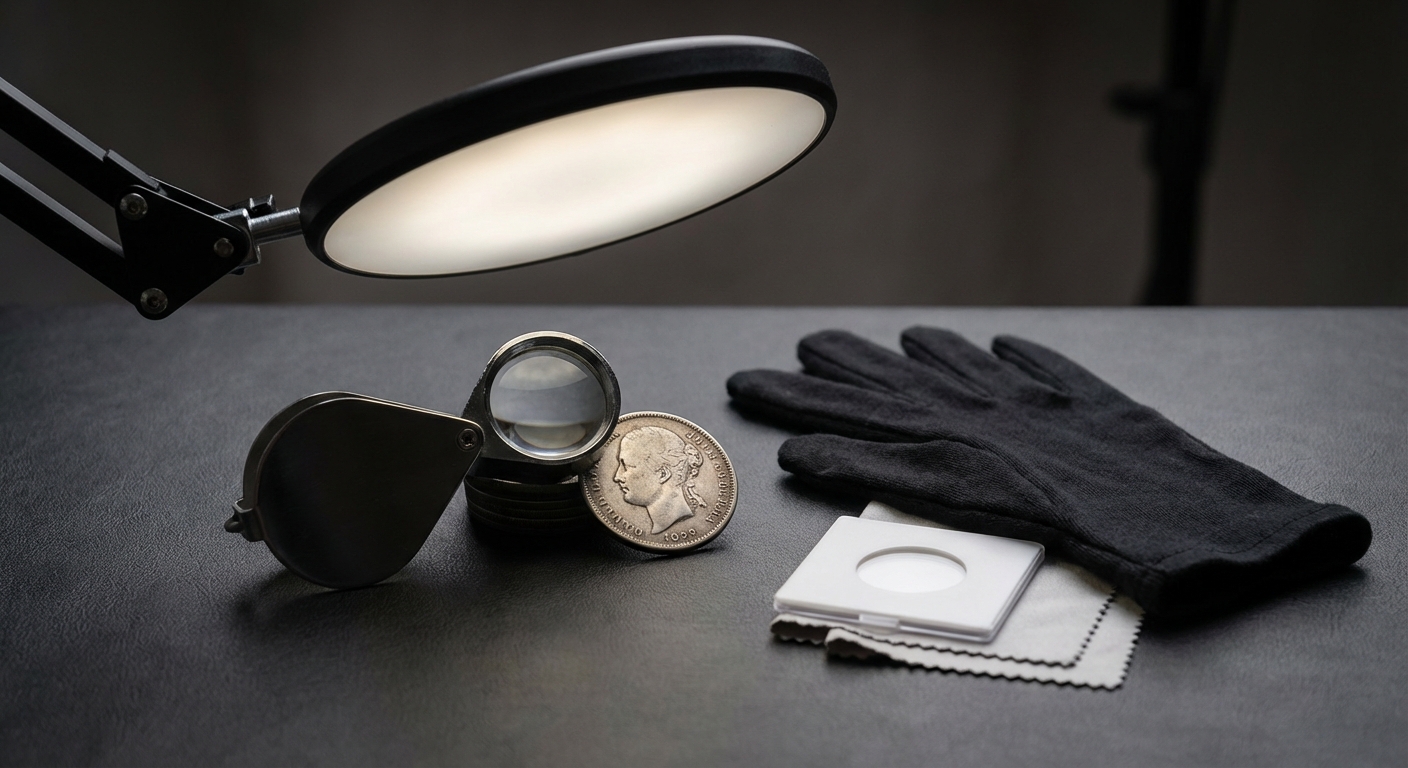
Before you start pre‑grading, set up a clean, stable workspace. Use a neutral background such as a white or gray desk pad to avoid color interference. Good lighting is essential: a single strong light source positioned to the side or slightly above the coin will reveal luster, marks, and surface texture. Many collectors prefer a daylight‑balanced LED lamp so colors and toning appear natural.
You will also need a loupe or magnifier in the 5x–10x range. Grading standards from organizations like the ANA are defined using modest magnification, not extreme zoom. Higher power magnification can make minor issues look worse than they are, leading you to under‑grade. Finally, wear cotton or nitrile gloves for high‑grade or proof coins, or handle coins only by the edges over a soft surface to avoid dropping or fingerprinting them. (money.org)
2. Confirm authenticity and identify the coin
Strictly speaking, authentication is separate from grading, but it should come first. Make sure you have correctly identified the coin’s type, date, mintmark and major variety. Compare weight, diameter, and design details to reliable catalog references or major certification service databases. If anything looks wrong—unusual color, incorrect dimensions, soft details unlike genuine examples—treat the coin with suspicion and seek expert help before worrying about its grade. (pcgs.com)
3. Take an overall first impression
With the coin under good light, look at it without magnification first. Ask yourself: Does it appear circulated or uncirculated? Is there obvious wear on the high points, or is the design sharp with full luster? Does the coin have generally good eye appeal, or do heavy marks, dark toning, or corrosion dominate your first impression?
This first glance is important because professional graders often rely on overall eye appeal to differentiate between tight numeric ranges. Try to decide whether the coin belongs in a broad category like Good–Fine, Very Fine, Extremely Fine, About Uncirculated, or Mint State before drilling down further. (thecoinsexplorer.com)
4. Locate and interpret wear patterns
Next, focus on the highest points of the design—these are the first to show wear in circulation. On many portrait coins, for example, look at hair curls, cheekbones, or laurel leaves. On reverse designs, check eagle breast feathers, shield lines, or high lettering. Use a loupe to compare these areas with reference photos for different grades from trusted guides or online grading tools. (coinsblog.ws)
If the highest points are flat and blend into adjacent areas, the coin is likely in the Fine or lower range. If detail remains but shows clear softening and only light wear, you may be in the VF or XF range. When only a trace of friction is visible at the very highest spots, and most luster remains, the coin often falls into About Uncirculated. Mint State coins should show no wear at all; any dullness you see must come from weak strike, bag marks, or toning, not from circulation. (thecoinsexplorer.com)
5. Evaluate luster and surfaces
Hold the coin flat and slowly tilt it under the light, watching for the cartwheel effect of luster moving across the surface. On higher‑grade circulated coins, luster may remain only in protected areas around letters or devices. If luster is mostly intact but broken on high points, AU is likely. If luster is patchy or largely gone, the coin is probably XF or lower. (americanbullion.com)
Then look for contact marks, scratches, spots, and other defects. Note both the number of marks and their location: a single heavy hit on the cheek of a portrait can be more damaging to the grade than several small marks in the fields. Very small ticks and hairlines are expected in most grades, but heavy gouges, rim nicks, or cleaning scratches may push a coin into a “Details” category even if the wear level is high grade. (money.org)
6. Consider strike quality and planchet issues
Distinguish weak strike from actual wear by comparing your coin to known examples for the type. If certain design elements are always soft on genuine coins, do not penalize your piece too harshly. Conversely, a sharp strike with strong details may justify placing a coin at the upper end of a grade band, even if the overall wear is similar to others. Planchet flaws such as small laminations or gas bubbles are usually tolerated to a degree but can influence eye appeal. (en.wikipedia.org)
7. Assign a realistic grade band
After you have assessed wear, luster, marks, and strike, choose a realistic grade band instead of chasing an exact number. For example:
- “Solid VF” – clear details with moderate even wear, little or no luster.
- “XF/AU borderline” – light wear with many sharp details and traces of luster in recessed areas.
- “Low Mint State” – no wear but many contact marks or dull luster (around MS‑60–62).
- “Choice Mint State” – no wear, fewer marks, good luster and eye appeal (roughly MS‑63–65). (thecoinsexplorer.com)
Write your pre‑grade in your inventory system so you can revisit it later. As your skills improve, you can adjust earlier estimates and learn from your own history.
8. Decide whether to submit for professional grading
Finally, consider whether your pre‑graded coin deserves submission to a major third‑party grading service. Factors include the coin’s rarity, market value at the likely grade, and your own goals. Professional grading adds authentication, precise grading, and a protective holder that many buyers prefer, but submission fees, shipping, and processing time can be significant.
According to major services, collectors can learn to grade with moderate accuracy over time, but expert judgment is still important for borderline and high‑value coins. Use your pre‑grading to filter candidates, then seek dealer or advanced collector opinions on the most valuable or uncertain pieces. (pcgs.com)
Common Mistakes and How to Avoid Them
Over-reliance on magnification
One of the most common beginner mistakes is grading almost entirely through a loupe. Extreme magnification makes every tiny tick or hairline look catastrophic, which can lead you to under‑grade coins. Professionals typically form their grade primarily at arm’s length, then verify details with modest magnification. Always start with the naked‑eye view and use the loupe to confirm, not to drive, your grading decision. (money.org)
Confusing wear with weak strike
New graders often misinterpret weakly struck details as circulation wear. For example, soft hairlines or flat stars that were never fully struck can look worn, even on Mint State coins. Comparing your coin to high‑resolution reference images for the same type and date, especially from grading services and auction archives, will help you distinguish strike weakness from real wear. (en.wikipedia.org)
Ignoring signs of cleaning or alteration
Cleaning is another major trap. Polished or abrasively cleaned coins often have unnatural, glossy surfaces, parallel hairlines, or a “washed out” look. Even if these coins are technically high grade in terms of wear, major grading services may refuse to assign them a numeric grade and instead label them with a “Details” designation describing the problem. Learning to spot cleaning, tooling, and repairs is essential; otherwise, you risk overpaying for impaired pieces. (ngccoin.uk)
Chasing the highest possible grade
Another mistake is trying to justify the highest plausible grade rather than the most realistic one. This often happens when collectors hope to hit a price jump at a specific threshold, such as MS‑65 instead of MS‑64. While this optimism is understandable, the market tends to reward conservative, consistent grading. Aim for a reasonable range, and remember that slight differences within a band are best left to professional graders.
Forgetting series-specific standards
Grading standards can effectively be tougher or looser for different series, even within the same numeric grade, because of typical strike, metal composition, or design. A VF ancient bronze, for example, can look very different from a VF modern silver coin. Always interpret generic grade descriptions in the context of the specific series, and rely on series‑specialized references and dealer experience where available. (warwickandwarwick.com)
Connection to Online Tools
Modern collectors have access to a wide range of online resources that make pre‑grading easier and more consistent. Major grading services offer image‑based tools where you can compare your coin to high‑resolution photographs of certified pieces at each grade level. These tools are especially useful when learning how wear, luster, and marks translate into the numeric scale across different series. (pcgs.com)
Beyond grading references, many hobby platforms and apps allow you to create digital coin cards, maintain an inventory, and track your own pre‑grades alongside later professional certifications. By recording your initial assessment and comparing it to final grades from reputable services, you can systematically improve your eye for condition. Inventory systems that support photos, notes, and grade fields also help you organize your collection and quickly identify which coins might be candidates for upgrades or submissions in the future.
Summary
Pre‑grading a coin yourself is about building a disciplined way of looking at wear, luster, surface quality, and strike. By following a structured process and comparing your coins to reliable references, you can place them into realistic grade bands that are good enough for most collecting decisions.
As your experience grows, your pre‑grades will align more closely with professional standards, helping you buy more confidently, avoid problem coins, and choose submissions wisely. Remember that grading is inherently subjective, so it is better to be consistently conservative than optimistically aggressive. When values are high or authenticity is in doubt, always seek expert opinions.
Finally, keep in mind that this article is for informational purposes only and does not constitute investment advice. Coin collecting combines history, artistry, and market dynamics; understanding condition is just one part of building a rewarding numismatic collection.
Frequently Asked Questions (FAQ)
What is the easiest way to start grading coins at home?
The easiest way to start is to set up good lighting, use a 5x–10x loupe, and compare your coins to clear online grading images for the same type. Focus first on whether the coin is circulated or uncirculated, then estimate a broad grade band like VF, XF, AU, or Mint State before worrying about exact numbers.
How can I tell if my coin is Mint State or About Uncirculated?
Look for any actual wear on the highest points of the design. A true Mint State coin shows no wear, only marks from handling at the mint. About Uncirculated coins may have tiny flat spots or dullness on high points and slightly broken luster, but still retain most of their original mint sheen. Comparing your coin to certified examples from grading services is very helpful.
Should I clean a coin before grading or submitting it?
No. Cleaning, polishing, or otherwise altering a coin’s surface almost always reduces its collectible value and can cause grading services to assign a “Details” label instead of a numeric grade. It is best to leave coins as they are and seek professional guidance if you think dirt or deposits might be removable without harm.
When is it worth sending a coin to a grading service?
It is usually worth submitting coins that are genuinely scarce or key dates, or common coins that appear to be in high grades where certification will significantly increase marketability and value. Compare the likely graded value to the total cost of submission, including fees and shipping, and be realistic about your pre‑grade before sending anything in.
Can I rely only on online tools instead of learning to grade myself?
Online tools are excellent aids, but they work best when combined with your own developing judgment. Use them to calibrate your eye, not to replace it. By practicing hands‑on grading and then checking your impressions against online references and certified coins, you will become a much more confident and effective collector.
