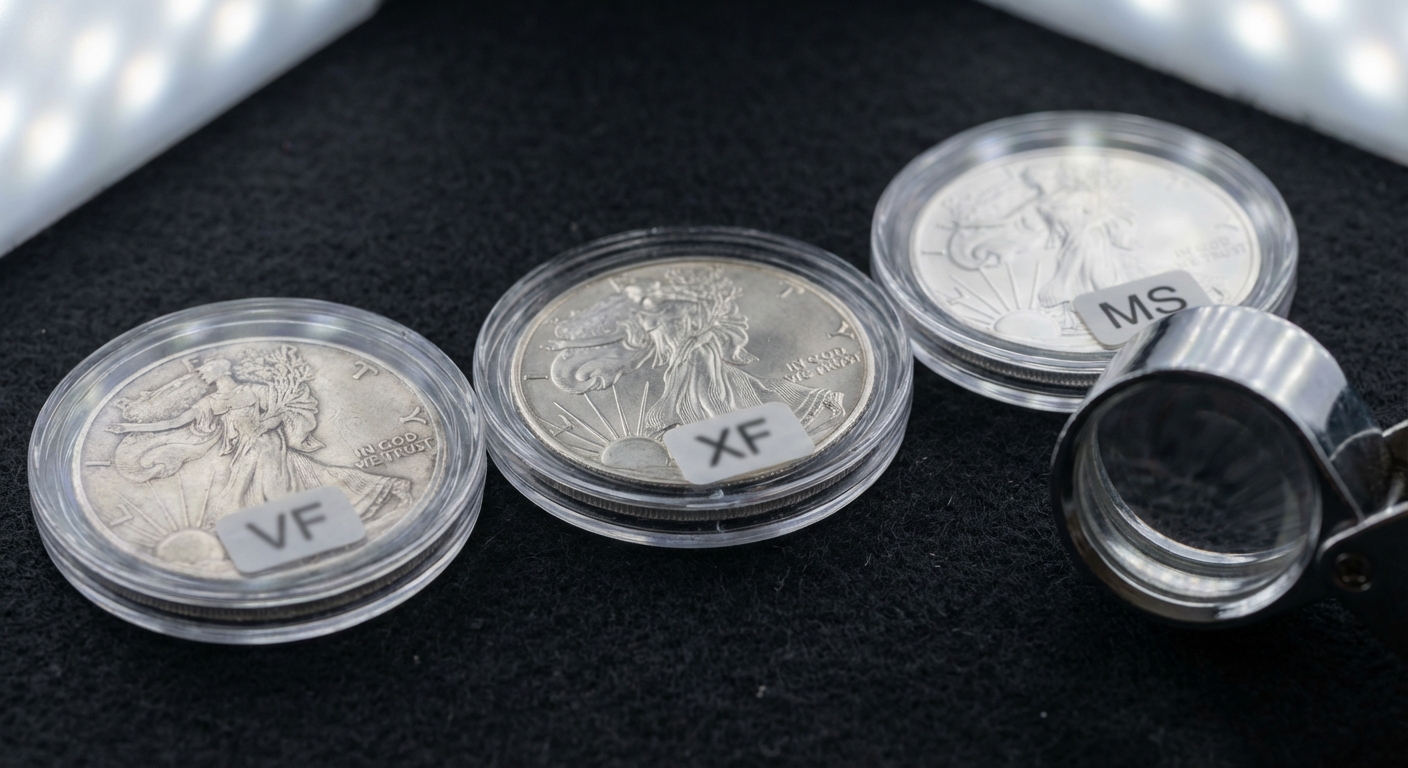
Understanding coin grades is one of the most important skills in numismatics. Abbreviations like VF, XF and MS appear in auction catalogues, dealer price lists and third‑party grading reports, yet many newer collectors only have a vague sense of what they mean. Misreading these grades can lead to overpaying, passing on good opportunities or mis‑cataloguing your own collection.
This article explains the coin grading scales used today, with a special focus on the popular terms Very Fine (VF), Extremely Fine/Extra Fine (XF/EF) and Mint State (MS). We will place them in the context of the 70‑point Sheldon scale, show how professional services such as NGC and PCGS apply them, and offer practical tips for evaluating coins at home. The goal is to give both beginners and intermediate collectors a clear, working understanding of these grades.
Whether you collect ancient bronzes, classic silver dollars or modern commemoratives, knowing what VF, XF and MS really mean will help you build a better coin collection and communicate more confidently with dealers, auction houses and fellow numismatists.
Basics and Definitions
Modern coin grading relies on the Sheldon scale, a 1–70 numerical system first proposed in 1949 by Dr. William H. Sheldon and later adopted by the American Numismatic Association and major grading services as an industry standard. (en.wikipedia.org) On this scale, 1 represents a barely identifiable coin (Poor), while 70 indicates a coin with no post‑production flaws visible under 5× magnification.
Within this framework, most collectors and grading services use a combination of words, abbreviations and numbers. The key circulated grade tiers are, from lowest to highest: Poor (P), Fair (FR), About Good (AG), Good (G), Very Good (VG), Fine (F), Very Fine (VF), Extremely Fine or Extra Fine (XF or EF), and About Uncirculated (AU). Uncirculated coins fall into Mint State (MS) and Proof (PF/PF), with MS and numeric grades from 60 to 70 for regular‑issue coins. (jmbullion.com)
VF, XF and MS sit roughly in the upper middle to high end of this scale. Very Fine (VF) covers coins with moderate wear but strong overall detail, typically in the numeric range of 20–35 depending on the service. XF (or EF) refers to coins with light wear on the highest points of the design, around 40–45 on the Sheldon scale. MS (Mint State) describes coins that show no actual wear from circulation and grade from 60 to 70. (jmbullion.com)
Professional grading services such as NGC and PCGS use these same terms and numbers, sometimes adding descriptors like Choice (Ch) or Gem to further refine grades (for example, Choice VF or Gem MS). (ngccoin.com)
Detailed Explanation
What “Very Fine” (VF) Really Means
Very Fine is the point at which a circulated coin remains clearly collectible but shows obvious, even wear. On the Sheldon scale, VF typically corresponds to VF‑20, VF‑25, VF‑30 and VF‑35. (jmbullion.com) At this level, all major design elements are visible, but finer details such as hair strands, feathers or small ornaments are partially worn.
According to common grading guides and major auction houses, a VF coin will show: (usmoneyreserve.com)
- Overall moderate wear across the entire surface.
- Major devices (portrait, date, legends, denomination) still bold and clear.
- Fine detail beginning to flatten, especially on the highest points.
- Minimal or no remaining mint luster on modern issues.
VF is often considered a “sweet spot” for many classic series: the coin is still attractive and historically legible, but not priced as aggressively as XF or AU examples. For ancient coins, VF can indicate a very desirable piece compared with the more heavily worn material often seen in the market. (ngccoin.com)
What “Extremely Fine” / “Extra Fine” (XF/EF) Means
XF (or EF, used interchangeably in many catalogues) denotes a coin with only light wear on the highest points and strong detail throughout. In the Sheldon system, XF grades include XF‑40 and XF‑45, with “Choice XF” usually aligned with 45. (coins.ha.com)
Typical characteristics of an XF coin include:
- All design elements present and sharp, with only the highest relief areas slightly flattened.
- Traces of mint luster often visible in protected areas for newer issues.
- Legends and rims complete and bold, with no merging into the fields from wear.
- Overall pleasing eye appeal, assuming surfaces are original and not cleaned. (usmoneyreserve.com)
For many series, prices jump noticeably from VF to XF, especially when demand is high for well‑detailed coins that remain visibly circulated but still show much of the original artistry. Auction records frequently highlight XF coins as “collector‑grade” examples that balance quality and affordability. (coins.ha.com)
What “Mint State” (MS) Means
Mint State is the most misunderstood term in coin collecting. MS does not mean “perfect”; it means the coin shows no wear from circulation. On the Sheldon scale, MS spans grades MS‑60 through MS‑70. (en.wikipedia.org)
At the low end (MS‑60 to MS‑62), a coin may be poorly struck or heavily marked from contact with other coins in bags, yet still count as uncirculated because its surfaces do not show actual wear. Higher Mint State levels such as MS‑65 and above (sometimes called Gem or Superb Gem) require strong luster, minimal contact marks and excellent eye appeal. Third‑party services define MS‑70 as a coin with no post‑production imperfections visible under 5× magnification. (ngccoin.com)
Because Mint State coins often command a premium, especially in high grades, the boundary between AU‑58 (a lightly worn coin) and low‑end MS can be financially significant. Collectors should understand that the difference can rest on subtle breaks in luster or very small friction on high points.
How VF, XF and MS Fit into the Whole Scale
VF, XF and MS form a continuum of increasing preservation, value and scarcity. Most coins produced for circulation will, over time, cluster in the lower to middle circulated ranges, with relatively fewer surviving in XF and AU and far fewer in Mint State.
Professional references show the following approximate mapping: VF around 20–35, XF around 40–45, AU from 50–58, and MS from 60–70. (jmbullion.com) Understanding this helps collectors compare coins across catalogues, grading services and world regions, since many British and European sources also describe grades like VF and EF while referencing the same underlying numeric ranges.
Advantages and Limitations of the Grading System
The Sheldon scale and its associated letter grades bring standardization to a market where condition drives value. They provide a common language for dealers, auctioneers and collectors, help researchers track price trends by grade and make it easier to buy coins sight‑unseen or online. (en.wikipedia.org)
However, grading remains partly subjective. Different services may assign slightly different grades to the same coin, especially near boundary lines such as VF/XF or AU/MS. Eye appeal, toning and strike quality also influence the perceived grade and price, even if the numerical grade is identical. Some specialists argue that for ancient or hammered coins, traditional VF/XF labels can mask issues like weak strikes or poor metal quality, so major services add separate evaluations for strike, surface and style. (ngccoin.com)
Practical Step-by-Step Guide
Step 1: Separate Circulated from Uncirculated
Begin by deciding whether a coin is circulated or Mint State. Tilt the coin under a good light and look for continuous breaks in luster on high points such as cheekbones on a portrait or central shield elements. Continuous dullness and flatness indicate wear and therefore a circulated grade (VF/XF/AU). If luster flows consistently across these high points and any dull areas are clearly from contact marks rather than smoothing, the coin may qualify as MS. (usmoneyreserve.com)
Step 2: Evaluate the Amount of Wear
For circulated coins, compare the degree of wear to standard references or online grading guides.
- If major design elements are bold but finer details are flattened across the coin, you are likely in the VF range.
- If only the very highest points show slight wear, with strong detail elsewhere, you are likely in the XF range.
- If wear is confined to tiny friction on just a few high spots, with luster still dominant, the coin may be AU. (jmbullion.com)
Many grading services and auction houses publish photographic guides for each grade tier in popular series. Using these as comparison tools greatly increases consistency.
Step 3: Consider Strike, Luster and Eye Appeal
Within any of the VF, XF or MS ranges, you should account for strike strength, surface quality and overall look. Weakly struck areas can mimic wear, especially on older or ancient coins. Leading grading services for ancient coins, such as NGC Ancients, explicitly separate grade from strike and surface ratings for this reason. (ngccoin.com)
Similarly, heavy contact marks, dull luster from overdipping or unattractive toning can pull a coin down within its grade range or make an MS‑60 coin less desirable than a lightly circulated but attractive AU or XF piece. Professional standards emphasize that factors such as scratches, rim nicks and corrosion all affect final grade and market value. (en.wikipedia.org)
Step 4: Use Magnification and Good Lighting
Most grading standards reference evaluation at around 5× magnification, especially for Mint State coins. NGC, for example, defines a 70‑grade coin as having no post‑production imperfections visible under 5×. (ngccoin.com) A basic 5×–10× loupe and a neutral, diffused light source will allow you to judge luster, hairlines and surface marks without harsh reflections.
When judging VF or XF, magnification helps distinguish true wear (rounded, smooth areas following the design) from surface dirt or strike softness. Always examine both sides and the edge if visible.
Step 5: Cross‑Check with Third-Party Opinions
If you are uncertain, compare your assessment with certified coins holdered by major services like NGC, PCGS or CAC Grading. Their published grading standards and image archives are invaluable for learning how professionals interpret VF, XF and MS in different series. (ngccoin.com)
For high‑value coins, many collectors rely on third‑party certification to reduce the risk of overgrading or missing subtle problems like cleaning or repair. Viewing numerous certified examples over time will sharpen your eye.
Common Mistakes and How to Avoid Them
Confusing Wear with Weak Strike
One of the most frequent errors is downgrading coins because of weakly struck areas that look like wear. On some early or ancient issues, almost all surviving examples show soft detail in specific places due to worn dies or poor striking pressure. Reputable grading standards note that such coins can still receive higher VF, XF or even AU/MS grades if the softness is clearly from strike, not wear. (en.wikipedia.org)
Solution: Study series‑specific references that point out known weak spots, and compare with better‑struck examples where available.
Overgrading Because of Cleaning or Polishing
Improper cleaning can give an illusion of sharp detail while destroying original surfaces and reducing value. Many over‑cleaned coins appear shiny at first glance, tempting beginners to call them XF or MS when professional graders see them as damaged pieces worth less than honestly worn VF examples. Professional services often label such coins with “details” grades rather than full numeric grades. (en.wikipedia.org)
Solution: Avoid harshly cleaned or polished coins, especially for long‑term collections. Original, even toning and natural luster are usually preferable to artificial brightness.
Ignoring Small Differences Between VF, XF and AU
The financial difference between a strong VF and a true XF, or between XF and AU, can be large in some series. New collectors often round everything to the nearest convenient label, such as calling a VF/XF border coin simply “XF”. Over time, this leads to inconsistent records and potential overpayment. (jmbullion.com)
Solution: When in doubt, be conservative in self‑grading and note your uncertainty (e.g., “VF‑30/35?” in inventory records). Let the market or a professional grader confirm the finer distinctions for expensive pieces.
Relying on Grade Alone for Value
Grade is only one component of a coin’s desirability. Eye appeal, rarity, provenance and demand within the series can all overshadow small grade differences. Auction archives show many VF or XF coins bringing strong prices because of exceptional toning or rarity, while technically higher‑graded MS pieces with poor eye appeal sell for less than expected. (coins.ha.com)
Solution: Use grade as a starting point, but always consider the coin as a whole. This article is for informational purposes only and does not constitute investment advice.
Connection to Online Tools
Modern coin collectors benefit from a growing ecosystem of online tools that make grading terms like VF, XF and MS easier to understand and apply. Many numismatic websites and grading services host digital image libraries where you can filter coins by grade, type and grading company. These visual comparisons help calibrate your eye to what VF‑30 vs. VF‑35, XF‑40 vs. XF‑45 or MS‑63 vs. MS‑65 actually look like in practice. (ngccoin.com)
There are also inventory and collection‑management platforms that let you record each coin’s grade (both your own estimate and, if applicable, a certified grade), purchase price, images and storage location. Some tools generate printable coin cards or online gallery views where grades are displayed alongside high‑resolution photos. These systems are particularly useful if you want to track grading consistency across a large numismatic collection or share parts of your collection with other collectors in a structured way.
Summary
VF, XF and MS are more than mysterious abbreviations: they are key landmarks on the Sheldon 1–70 scale that describe how much of a coin’s original detail and surface quality remains. VF coins show moderate but even wear with all major design elements visible; XF pieces have only light wear on the highest points; and MS coins display no wear from circulation at all, though they may still have bag marks or strike issues. (jmbullion.com)
By learning how to separate circulated from Mint State coins, assess the amount of wear, and factor in strike, luster and eye appeal, you can apply these grades more confidently to both raw and certified coins. Being conservative, avoiding cleaned pieces and consulting professional standards or online image archives will help you avoid many common grading pitfalls.
Ultimately, grade should serve your collecting goals rather than dominate them. Use VF, XF and MS as tools for understanding condition and value, but also pay attention to historical interest, rarity and personal appeal. This article is for informational purposes only and does not constitute investment advice.
Frequently Asked Questions (FAQ)
What is the difference between VF and XF in coin grading?
VF (Very Fine) coins show moderate, even wear over the whole design, with fine details flattened, while XF (Extremely Fine) coins have only light wear on the highest points and retain sharper detail overall, often with traces of luster in protected areas. (jmbullion.com)
What does MS mean on a coin grade?
MS stands for Mint State and refers to coins that show no wear from circulation. On the Sheldon scale, Mint State grades run from MS‑60 to MS‑70, with higher numbers indicating fewer marks, stronger luster and better eye appeal. (ngccoin.com)
How can I tell if my coin is uncirculated or just About Uncirculated?
To separate AU from MS, examine the highest design points under good light and modest magnification. If there is clear, smooth wear that breaks the luster, the coin is AU; if luster is continuous and any dull areas are from contact marks rather than smoothing, it may qualify as Mint State. Professional references and certified examples are helpful comparison tools. (usmoneyreserve.com)
Are grading standards the same for ancient coins and modern coins?
Ancient coins often use the same VF, XF and MS labels, but major services also add separate strike, surface and style ratings because issues like weak strikes and rough flans are common. As a result, an ancient coin called VF or XF might look different from a modern VF or XF piece even though the same terms are used. (ngccoin.com)
Should I always buy the highest grade coin I can afford?
Not necessarily. Higher grades often cost disproportionately more, and grade is only one factor in desirability. Many collectors prefer well‑struck VF or XF coins with attractive toning over lower‑end Mint State pieces with poor eye appeal. Consider your budget, series goals and personal taste rather than chasing the highest possible grade. This is not investment advice. (coinweek.com)
