New collectors are often tempted to make their coins shine. A bright, mirror-like surface feels cleaner and more attractive than dark toning or dull patina. Yet in numismatics, cleaning is one of the fastest ways to destroy a coin’s value and its historical appeal.
This article explains when, if ever, you should clean coins, and what professional numismatists actually mean by cleaning, conservation and damage. It is designed for beginners, inheritors of collections and experienced coin collectors who want to avoid costly mistakes.
Drawing on the practices of major dealers, grading services and auction houses, we will look at the facts, myths and risks of coin cleaning, and outline safe alternatives for preserving your collection. This article is for informational purposes only and does not constitute investment advice.
Basics and Definitions
In coin collecting, most professionals draw a sharp line between cleaning and conservation. Cleaning usually means trying to improve appearance by rubbing, polishing or chemically stripping the surface. Conservation aims to stabilize the coin and remove active contaminants with minimal impact on the original surfaces.
According to numismatic guides and major bullion dealers, aggressive cleaning almost always reduces a coin’s value, especially for collectible pieces, because it disturbs the surface, removes patina and leaves hairlines that are obvious under magnification. (jmbullion.com)
Another essential concept is patina or natural toning. Over time, metals react with their environment and form a thin surface layer. Far from being mere dirt, this patina is often regarded as proof of age and authenticity, particularly on historic and ancient coins. Removing it erases part of the coin’s story and can even trigger forms of corrosion such as bronze disease on ancient bronzes. (en.wikipedia.org)
Professional grading services like PCGS and NGC evaluate coins not only for wear but also for originality. Coins that have been obviously cleaned are often labeled with a “details” grade or explicitly described as cleaned or polished, which significantly lowers their market appeal. (jmbullion.com)
Detailed Explanation
The core rule repeated by major numismatic dealers is simple: do not clean collectible coins. JM Bullion, specialist rare coin dealers and auction houses emphasize that cleaning almost always decreases numismatic value, even when the result looks shinier to the naked eye. (jmbullion.com)
There are several mechanisms behind this loss of value. First, mechanical cleaning methods—such as rubbing with a cloth, using a brush, or applying polishing compounds—create microscopic scratches known as hairlines. Under direct light or magnification these hairlines stand out, and experienced graders instantly recognize them as signs of improper cleaning. (schulman.nl)
Second, abrasive or chemical methods can remove metal from high points of the design. Over time, repeated or harsh cleaning may round off details, making a once-sharp coin appear flat and lifeless. Historical accounts note that in the nineteenth and early twentieth centuries, collectors widely used erasers, strong chemicals and even wire brushes, leaving many otherwise rare coins permanently impaired. (nationalnumismaticgroup.com)
Third, cleaning often strips away original patina and toning. Many collectors and auction houses pay a premium for coins that show attractive, natural color. Removing that layer can erase visual evidence of age and authenticity. On gold coins, for example, patina contributes to perceived originality; cleaning can cause color distortion or patchy surfaces that specialists immediately regard as damage. (goldmarket.fr)
Fourth, chemical dips and household cleaners can leave residues that continue reacting with the metal, leading to unnatural re-toning, spots or accelerated corrosion. Over-dipping a coin—leaving it too long in a chemical solution—can permanently destroy luster and give the piece a dull, washed-out appearance that grading services penalize heavily. (nationalnumismaticgroup.com)
For these reasons, major references and collector communities strongly discourage cleaning in almost all cases. The accepted approach is to preserve coins as they are, focus on proper storage and handling, and if necessary, use professional conservation services rather than do-it-yourself cleaning. (jmbullion.com)
Practical Step-by-Step Guide
In practice, you will encounter coins in many different states—from dirty pocket change to high-grade numismatic pieces or hoard finds covered in soil. The following step-by-step framework helps you decide what to do, with an emphasis on avoiding harm.
Step 1: Identify the coin and its potential value
Before considering any cleaning, identify the coin’s type, date, mintmark and condition. Use standard catalogues or reputable online databases, and when in doubt, assume the coin could be valuable. Once a coin is cleaned, any surface damage or lost patina is irreversible, so the safest assumption is always to treat it as potentially important. (therarecoinstore.com)
Step 2: Ask whether cleaning is truly necessary
Most of the time, the honest answer is “no.” Mild toning, uniform darkening, or light soil in recessed areas usually does not justify intervention. Patina is part of the coin’s character and, in many cases, part of its value. According to multiple dealer guides, coins destined for appraisal or grading should never be cleaned by the owner beforehand. (jmbullion.com)
The few situations where some form of cleaning or conservation might be appropriate include coins with active corrosion, heavy encrustations that obscure identification, or damaging contaminants such as PVC residue or adhesives. Even in these edge cases, professional help is strongly recommended. (numismaticos.com)
Step 3: Consider professional conservation
Professional conservation, offered by some major grading services and specialized firms, focuses on stabilizing the coin and removing harmful substances with minimal impact on original surfaces. Services associated with PCGS or NGC, for example, are designed to be consistent with grading standards and to avoid the tell-tale signs of amateur cleaning. (jmbullion.com)
If your coin is rare, historically important or in high grade, professional conservation is almost always preferable to any do-it-yourself method. The cost of conservation is typically small compared with the loss of value caused by visible cleaning damage.
Step 4: If you must clean low-value coins, proceed minimally
Some references suggest that gently cleaning common, heavily circulated coins or modern bullion intended only for metal value can be acceptable, as long as you understand that you are not dealing with high-end numismatic material. (gainesvillecoins.com)
If you decide to proceed with such low-risk coins, follow conservative principles drawn from numismatic care guides:
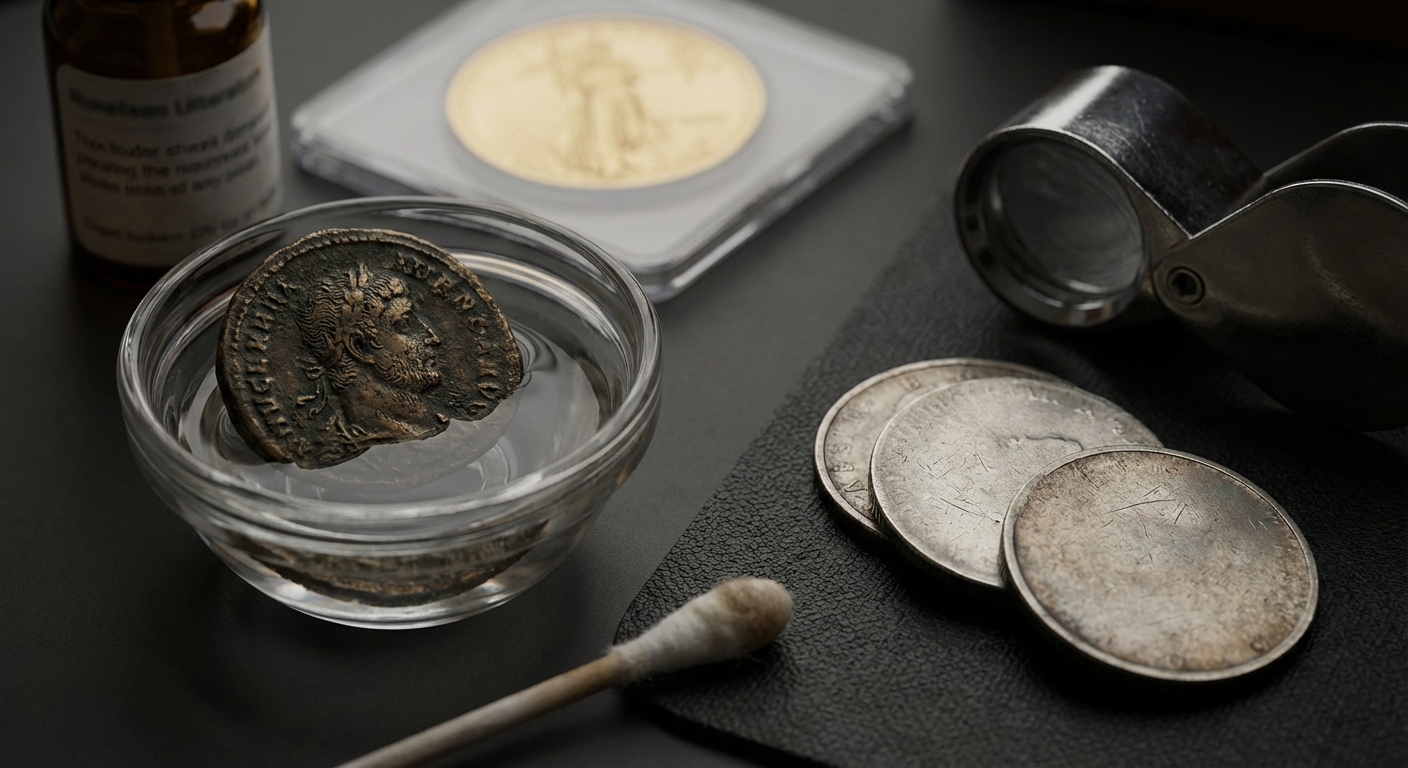
- Handle coins only by the edges, ideally while wearing cotton or nitrile gloves.
- Use distilled water, not tap water, to avoid minerals and chlorine.
- If loose dirt must be removed, let the coin soak in distilled water and gently rinse; avoid rubbing.
- Never use abrasive materials (toothpaste, baking soda, metal polish, erasers) or harsh chemicals.
- Pat the coin dry on a soft, lint-free cloth or allow it to air-dry; do not wipe.
Even with these precautions, remember that any alteration of the surface can be visible to experts and may still reduce collector interest. These minimal steps are a last resort, suitable only for coins with no realistic numismatic premium.
Step 5: Prioritize storage and handling over appearance
The most effective way to keep coins attractive is not to clean them but to prevent new damage. Numismatic care guides recommend storing coins in inert holders (such as archival-quality flips, capsules, or acid-free cardboard mounts), avoiding PVC plastics and humid environments, and limiting handling. (gainesvillecoins.com)
By minimizing exposure to skin oils, air pollutants and moisture, you reduce the need for any future intervention and preserve the originality that collectors and grading services prize.
Common Mistakes and How to Avoid Them
Despite the clear warnings, many beginning collectors repeat the same errors. Understanding these common mistakes will help you protect your collection and avoid costly lessons.
Using household cleaners or abrasive methods
Household products such as vinegar, lemon juice, baking soda, toothpaste and commercial metal polishes are among the worst choices for coin cleaning. Numismatic conservation articles document how such substances etch metal surfaces, strip patina and leave visible scratches. (numismaticos.com)
How to avoid it: Never treat coins like kitchenware. If a product is designed to polish silverware or bathroom fixtures, it is almost certainly unsuitable for numismatic material.
Polishing coins to make them “shiny”
Polishing with cloths, brushes or commercial polishing agents can make coins appear bright in normal light, but under professional inspection the surface is covered in hairlines. Auction houses and grading services often downgrade polished coins heavily; some European auctioneers explicitly treat “polished” as synonymous with degraded. (schulman.nl)
How to avoid it: Accept that original luster and attractive natural toning are more desirable than artificial shine. A dull but original coin is usually worth far more than a bright, polished one.
Cleaning before appraisal or grading
One of the most expensive mistakes is cleaning coins immediately after discovering them, especially inherited collections. Dealer guidelines stress that you should never clean coins before a professional appraisal, because any attempt to improve their appearance can only reduce their value. (keywellcollectibles.com)
How to avoid it: Handle newly found coins gently by the edges, keep them in their existing holders or envelopes, and take them to a reputable dealer or submit them to a grading service without any alteration.
Ignoring storage and environmental damage
Leaving coins in damp basements, PVC flips or containers not intended for numismatics can cause green residue, corrosion spots and other forms of irreversible damage. Conservation guides point out that improper storage is one of the leading causes of deterioration in private collections. (numismaticos.com)
How to avoid it: Use holders made from inert materials, control humidity with desiccants when needed and keep coins away from direct sunlight and fluctuating temperatures.
Overestimating DIY skill
Even experienced collectors often underestimate how easy it is to over-dip a coin, miss chemical residues or apply too much pressure when handling fragile surfaces. Dealer and community discussions highlight that once damage is done, it cannot be undone, and cleaned coins may lose 50–90% of their potential value. (schulman.nl)
How to avoid it: Be honest about your skills and tools. When in doubt, do nothing and consult a professional conservator or grading service.
Connection to Online Tools
Modern collectors have access to a wide range of online tools that make it easier to manage a collection without resorting to cleaning. Inventory software and mobile apps let you catalog each coin with photos, grades, provenance notes and storage location, allowing you to track condition over time and notice any emerging problems such as spots or corrosion without frequently handling the coins themselves.
Web-based platforms and collection management systems can also generate printable coin cards, album labels and digital displays that showcase your collection’s best pieces using high-resolution photography. By presenting coins through images instead of physically polishing them for display, you preserve delicate surfaces while still sharing your numismatic interests with others.
Summary
Cleaning coins is far riskier than many beginners realize. Mechanical and chemical methods can scratch surfaces, strip patina, and lead to grading penalties that dramatically reduce numismatic value. Professional literature and dealer guidance are nearly unanimous: collectible coins are best left uncleaned. (jmbullion.com)
Instead of chasing artificial shine, focus on careful identification, conservative handling and high-quality storage. When contaminants or corrosion genuinely threaten a coin, professional conservation is the safest route. For common, low-value pieces where experimentation is less risky, any cleaning should be minimal, non-abrasive and undertaken with the understanding that it may still lower value.
By respecting original surfaces and using online tools to document and display your holdings, you can protect both the financial and historical significance of your collection. This article is for informational purposes only and does not constitute investment advice.
Frequently Asked Questions (FAQ)
Should I clean old coins I found in a box or attic?
No. Do not clean old coins before you know what they are. Leave them as-found, store them safely and seek an appraisal or consult reference books. Cleaning can permanently reduce value by damaging surfaces and removing patina recognized by experts.
Does cleaning coins decrease their value?
For collectible coins, cleaning almost always decreases value. Grading services and dealers can see signs of cleaning, often assigning a lower “details” grade or discounting the price heavily compared with an original, uncleaned example of the same type.
When is it acceptable to clean a coin?
It may be acceptable to gently clean common, heavily circulated coins or bullion pieces that have no numismatic premium, or to address active corrosion and harmful residues under professional guidance. Even then, methods must be minimal and non-abrasive, and the risk to value should be understood.
What is the safest way to remove dirt from a coin?
The safest approach is to avoid cleaning entirely and consult a professional. If you must address loose dirt on a low-value coin, numismatic care guides suggest soaking in distilled water and gently rinsing without rubbing, then allowing the coin to air-dry on a soft, clean surface.
How can I keep my coins looking good without cleaning them?
Use proper coin storage such as inert flips, capsules or archival-quality holders; control humidity; avoid PVC plastics; and handle coins only by the edges with clean hands or gloves. Good storage and minimal handling preserve attractive natural toning and luster without any need for cleaning.
