Numismatics, the study and collection of currency, is a deeply rewarding hobby that connects enthusiasts to history, art, and economics. However, where there is value, there is also the risk of fraud. The market is constantly targeted by counterfeiters who produce convincing copies of rare and valuable coins, making authenticity a paramount concern for every collector, from the beginner to the seasoned expert. This article serves as an essential primer on the most common types of coin forgeries and provides practical, step-by-step techniques to help you spot them, safeguarding your collection and investment.
Disclaimer: This article is for informational purposes only and does not constitute investment advice. Professional authentication by a trusted grading service is always recommended for high-value purchases.
Basics and Definitions
In the world of coin collecting, it is crucial to understand the different categories of non-genuine coins. Forgeries are generally defined as objects made with the intent to deceive a collector or the public, usually for financial gain . (goldmarket.fr) They fall into several major categories based on their production method:
- Counterfeits: Illegal copies intended to deceive, either as fake currency or as copies of rare coins sold at high premiums . (physicalgold.com)
- Cast Counterfeits: Coins made by pouring molten metal into a mold taken from a genuine coin. This is one of the oldest and often crudest forgery techniques . (forumancientcoins.com)
- Die-Struck Counterfeits (Transfer Dies): Coins made by striking a blank planchet with dies that have been illicitly replicated from an authentic coin. These are typically the most sophisticated and deceptive fakes . (pcgs.com)
- Altered Coins: Genuine coins that have been modified to appear as a rarer or more valuable variety, such as by adding or removing a mintmark or changing a date . (americanrarities.com)
- Electrotypes: Shells of metal created through an electrolytic process, often by museums to create replicas for display, but sometimes filled and joined together to create a fake coin . (calgarycoin.com)
Detailed Explanation of Forgery Techniques
Casting: The Traditional Forgery
Casting involves using a mold made from a real coin to produce a copy. This method, while simple, leaves distinctive, tell-tale signs. The casting process rarely captures the fine details of a genuine coin’s design, resulting in a slightly ‘soft’ or ‘fuzzy’ appearance . Furthermore, the molten metal often traps tiny air bubbles, which manifest as microscopic pits or a grainy texture (pitting) on the coin’s surface . (usgoldbureau.com) Critically, the process of joining the two mold halves often leaves a faint but visible seam around the coin’s edge, which skilled counterfeiters try to file or tooling to remove . (pcgs.com) Cast counterfeits are also frequently made with base metals, leading to an incorrect weight or specific gravity compared to the genuine, official coin . (grandrapidscoins.com)
Die Striking and Transfer Dies: The Sophisticated Threat
Modern counterfeiters increasingly favor the die-striking method because it produces coins with a sharp, high-quality finish that closely mimics genuine mint production . The most common form of this is using ‘transfer dies,’ which are working dies created by transferring the image from a genuine coin. While these fakes can be excellent, they inherit any flaws or defects from the original coin used to create the die. Moreover, high-quality, modern counterfeits often have an unnatural, overly sharp appearance, lacking the subtle flow lines—the microscopic patterns in the metal caused by the immense pressure of a genuine mint strike—that are present on authentic coins . (grreserve.com) This method is costly and requires significant skill, but allows for the mass production of highly deceptive fakes .
Altered and Plated Coins: Deception through Modification
Unlike outright fakes, altered coins start as genuine, low-value pieces that are modified to resemble a rare and expensive variation. A common alteration is the addition of a mintmark, such as a rare ‘S’ or ‘CC,’ often done by fabricating a mark, soldering one cut from a common coin, or embossing the surface . An experienced eye can spot these changes by looking for an unnatural seam, discoloration, or an incorrect style/spacing of the mark under magnification . (youtube.com) Plating is another alteration technique, where a base metal coin is coated with a thin layer of precious metal, such as gold or silver, to create a valuable bullion coin or rare issue . These are often detected by checking the coin’s weight or using a magnet .
Practical Step-by-Step Guide to Authentication
Authenticating a coin is a multi-step process that combines physical inspection with scientific measurement. The following methods, often used by professional numismatists, will significantly increase your ability to detect a forgery.
Step 1: The Visual Examination (The Loupe Test)
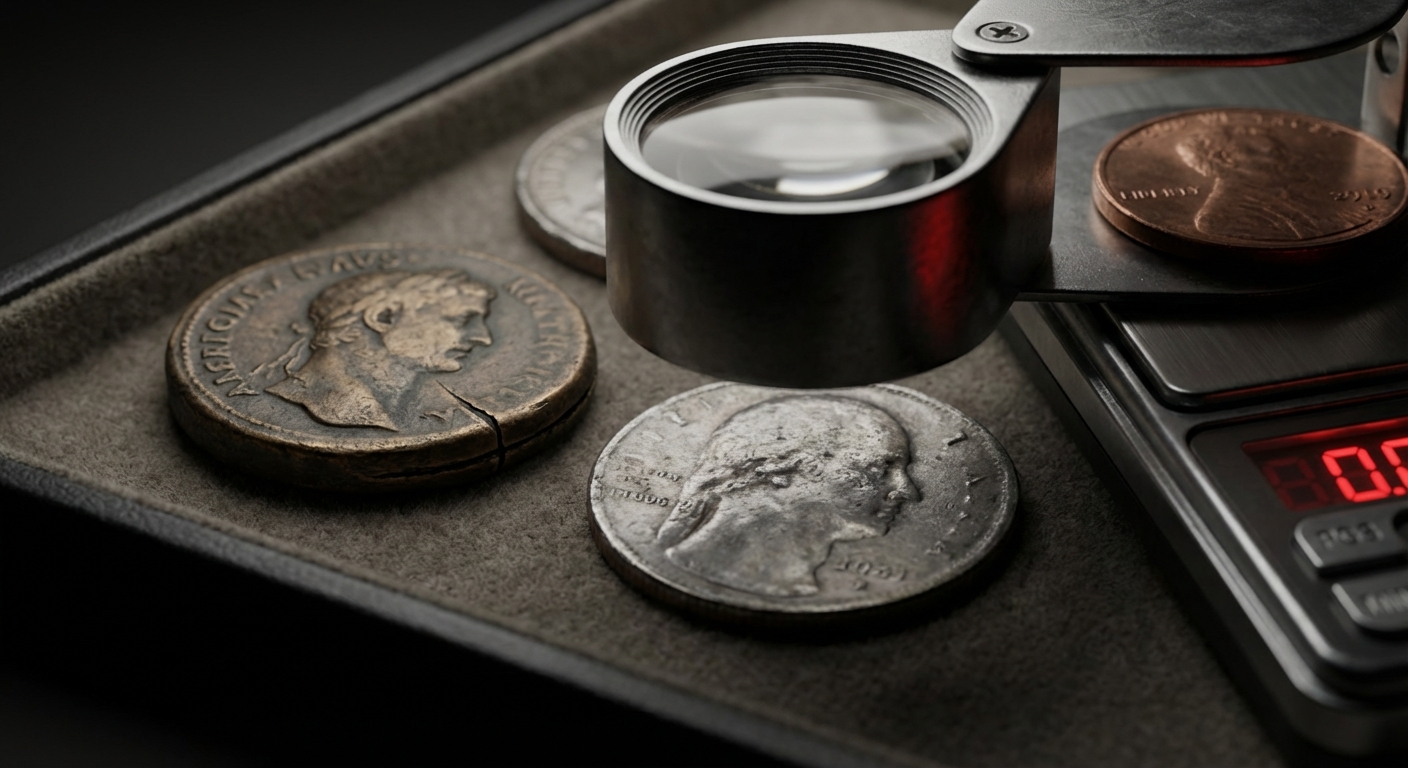
Always begin with a slow, thorough visual inspection, ideally with a jeweler’s loupe offering 10x to 20x magnification . (coin-identifier.com)
- Look for Softness and Pitting: Genuine struck coins have sharp, crisp details. Look closely at the fine elements like hair, letters, and dates. Softness or mushy details, often accompanied by microscopic air bubbles or pitting on the surface, are strong indicators of a cast forgery .
- Examine the Fields and Edges: Rotate the coin under a bright, dynamic light. Look for unnatural flow lines, tiny tool marks, or a seam on the edge. The edge is a counterfeiter’s most challenging element to perfect, and a visible seam is a major red flag for cast or electrotype pieces .
- Check Inscriptions and Dates: Scrutinize the lettering, spacing, and mintmarks. Inconsistencies, incorrect font styles, or signs of tooling (e.g., discoloration or disturbed metal) around an added mintmark or altered date are clear indicators of tampering .
Step 2: The Weight and Dimension Test
Genuine coins are produced to extremely precise governmental standards. Any significant deviation from these specs is a primary sign of a fake . (greatamericancoincompany.com)
- Weight: Use an accurate digital scale (preferably measuring to 0.01 grams) to weigh the coin. Compare the reading to the official specifications for that coin and mint. Counterfeits made from cheaper base metals are frequently underweight, or occasionally overweight if a denser, incorrect alloy was used .
- Dimensions: Use a set of precise digital calipers to measure the coin’s diameter and thickness. Even minor inconsistencies, such as being a fraction of a millimeter off, can be a giveaway missed by the counterfeiter .
Step 3: The Magnet and Sound Test
- Magnet Test: Most precious metals used in high-value collector coins, such as gold and silver, are non-magnetic. If a coin that is supposed to be pure gold or silver is attracted to a strong magnet, it almost certainly contains a steel or iron base-metal core and is a modern forgery .
- Sound Test (Ping Test): The unique acoustic properties of pure gold and silver produce a distinct, high-pitched ‘ring’ when gently struck (or ‘pinged’) against a hard surface, or another coin. Counterfeits, especially cast ones or those made of base metals, will produce a dull, flat ‘thud’ . (copperstatecoin.com)
Step 4: Advanced Verification (Specific Gravity)
For high-value or highly suspected coins, the specific gravity test determines the coin’s density. This involves measuring its dry weight and its submerged weight (using water, a scale, and a calculator). The result must match the known density of the coin’s metal composition. This test is non-destructive and highly effective because counterfeiters rarely use the correct metal alloy . (youtube.com) Professional grading services and some dealers will also use X-ray Fluorescence (XRF) to non-destructively determine the exact elemental makeup of a coin’s metal . (ngccoin.com)
Common Mistakes and How to Avoid Them
Even experienced collectors can fall victim to sophisticated forgeries. Avoiding common pitfalls is a key part of protecting your collection:
- Mistake: Ignoring the Price. If a rare coin is offered at a price that seems ‘too good to be true’—significantly below established auction or catalogue values—it is almost certainly a counterfeit .
- Mistake: Buying the Grade, Not the Coin. Focusing only on the numerical grade on a holder without examining the coin itself. Counterfeiters increasingly target the plastic slabs used by major grading services, replacing the genuine coin with a fake . (coinsarefun.com)
- Mistake: Rushing to Magnification. Numismatic experts advise examining the coin first with the naked eye under dynamic light, rotating it slowly. Many major flaws, such as incorrect overall color or an obviously suspicious edge, are missed when a collector immediately goes straight to the loupe .
- Mistake: Forgiving Red Flags. Ignoring gut feelings or trying to rationalize clear problems on a coin (like a slight discoloration or a soft-looking letter) simply because you want that coin for your collection .
- Mistake: Cleaning Coins. Attempting to clean a genuine coin to enhance its appearance is never recommended, as it can create unnatural hairline scratches, destroy the natural toning (patina), and reduce its collector value by up to 90% .
Connection to Online Tools
For the modern numismatist, a variety of online resources have become invaluable authentication tools. Digital catalogs and reference websites provide the precise technical specifications—weight, diameter, thickness, and composition—for thousands of coins, allowing collectors to perform accurate comparisons against their physical specimens . Furthermore, online image databases from major auction houses and professional grading services (like PCGS or NGC) offer high-resolution photographs of certified, authentic examples. Comparing a suspicious coin directly against multiple known-good images can reveal subtle discrepancies in detail, die-alignment, or font that a counterfeiter may have missed . Collectors can also utilize online inventory systems to track the provenance (history of ownership) of their coins, which adds a layer of security and authenticity to the collection.
Summary
The threat of coin forgeries is real and constantly evolving, with techniques ranging from crude casting to highly sophisticated die-striking. However, by arming yourself with knowledge and essential tools, you can dramatically reduce your risk of acquiring a fake.
The key to successful authentication lies in a methodical approach: start with a detailed visual inspection using a quality loupe, meticulously check the weight and dimensions against official specifications, and use the simple magnet and sound tests for precious metal pieces. Always remember that the most secure defense is purchasing coins from reputable, established dealers who offer guarantees of authenticity and by utilizing third-party professional grading services for all high-value acquisitions.
Frequently Asked Questions (FAQ)
What are the most common signs of a cast counterfeit coin?
The most common signs of a cast counterfeit are soft or blurry details, a visible seam around the edge where the molds joined, and a pitted or grainy surface texture caused by air bubbles during casting. These coins are also often lighter than the official weight .
How can I use the magnet test to check for fake gold or silver coins?
Genuine gold and silver are non-magnetic. If a coin advertised as being made of one of these precious metals is attracted to a strong magnet, it is likely a modern fake made with a base metal core containing iron or steel .
What is the difference between a counterfeit and an altered coin?
A counterfeit is a coin made entirely from scratch (such as a cast or struck fake) with the intent to deceive. An altered coin is a genuine, low-value coin that has been physically modified (e.g., by adding a mintmark or changing a date) to resemble a rarer, high-value variety .
Why is the weight of a coin so important in forgery detection?
The weight is critical because a genuine coin is struck to extremely precise standards. Counterfeiters often use incorrect, cheaper metal alloys that result in a weight that is noticeably off the official specification, which is easily detected with an accurate digital scale .
