The excitement of acquiring a rare or valuable coin is one of numismatics’ greatest pleasures, yet this joy is often tempered by a collector’s most pressing concern: authenticity. The market is increasingly flooded with sophisticated counterfeit coins, making the ability to distinguish a genuine historical artifact from a clever modern forgery an indispensable skill for both seasoned investors and novice enthusiasts. (goldsilverjapan.com)
This guide offers a foundational, non-destructive workflow for detecting counterfeit coins, focusing on simple techniques and affordable tools that every collector can use at home. By mastering basic visual and physical inspection methods, you can significantly safeguard your collection and investment from financial and emotional loss. (cavaliercoins.com)
Basics and Definitions
In numismatics, a “fake” coin can fall into several categories, each created with the intent to deceive. The two primary types of manufacturing fraud are cast and struck counterfeits. Counterfeiters also commonly employ methods of alteration to manipulate genuine, low-value coins into appearing as a rarer and more expensive variety. (physicalgold.com)
Types of Counterfeits and Alterations
- Struck Counterfeits: These are produced using dies and a press, mimicking the official minting process. They can be difficult to detect because the strike detail is often sharp, but the metallic composition is usually compromised to reduce cost.
- Cast Counterfeits: Produced by pouring molten metal into a mold, these fakes often exhibit signs of casting, such as a rough or granular surface texture, a lack of fine detail, and tiny pits or air bubbles. A visible seam or filing marks along the edge where the mold was joined are key indicators. (grandrapidscoins.com)
- Altered Coins: These are genuine coins that have been modified to appear rarer, most often by tooling or cutting to add, remove, or change a mintmark or the coin’s date. A close examination of these areas may reveal unnatural scratch marks, or the date/mintmark may appear to be applied to the surface rather than struck into it. (coinsblog.ws)
The basic detection methods covered in this article rely on the principle that it is nearly impossible for a counterfeiter to perfectly replicate a coin’s correct design details, metal composition, and precise physical dimensions simultaneously. (itmtrading.com)
Detailed Explanation of Essential Physical Tests
Before proceeding to professional or potentially destructive tests, collectors should employ a series of physical checks that leverage simple physics and material science.
The Weight and Density Check
Authentic coins are produced by sovereign mints to extremely precise specifications, including their mass. The official weight of a coin is a critical physical property that counterfeiters struggle to replicate perfectly because they typically use cheaper base metals with different densities. (rosehillcoins.com)
For instance, a genuine 1-ounce American Silver Eagle should weigh 31.1 grams. A coin that is significantly underweight is often a base metal fake, while one that is slightly too heavy or too light may indicate an improper alloy or wear outside of normal mint tolerance. Numismatic catalogues and official mint specifications are the primary reference for this data. (qualitycollectiblecoins.com)
The Magnet Test for Precious Metals
The vast majority of genuine gold, silver, and platinum coins are non-magnetic. If a strong magnet is applied to a coin that is supposed to be composed of a precious metal, a strong attraction suggests a counterfeit containing ferrous base metals like iron or steel. (usgoldbureau.com)
However, this test is not foolproof; some counterfeiters use non-magnetic base metals like lead or copper, which will pass the magnet test. Furthermore, a few genuine coins, such as the 1943 Lincoln steel cent, are known to be magnetic and must be checked against their official composition.
Acoustic Testing: The Ping Test
High-purity gold and silver have unique sonic properties that result in a distinctive, sustained, high-pitched ring when gently struck, which gives this method its name. Counterfeit coins, especially those cast or made with base metal alloys, will often produce a duller or flatter sound, sometimes described as a “thud.” (copperstatecoin.com)
Collectors should exercise caution when performing the ping test, as striking a highly graded or proof coin can cause damage to the rim or surface, potentially impairing its numismatic value. It is advisable to perform this test only on a coin whose value would not be significantly affected by potential minor abrasion. (bullion.com)
Practical Step-by-Step Authentication Guide
A systematic process combining visual scrutiny with physical measurement is the most reliable way to perform an initial authentication.
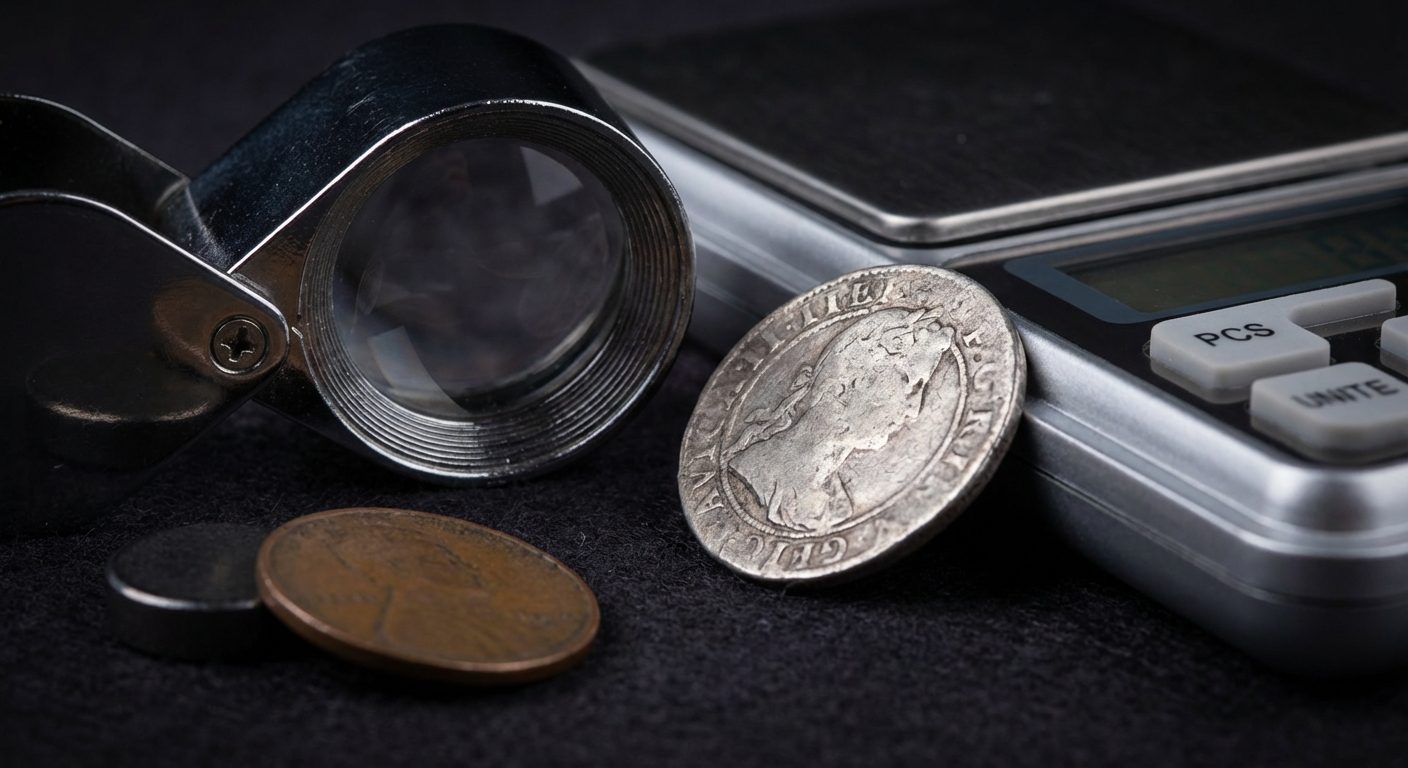
- Gather Your Tools: You will need a digital scale accurate to at least 0.01 grams, a set of digital calipers for precise dimensional measurements, a high-powered loupe (8x to 10x magnification), a strong neodymium magnet, and cotton gloves to prevent damage from skin oils.
- Source and Reference Known Data: Before handling the coin, find the official specifications for its type, denomination, and year. This includes the precise weight, diameter, and thickness, typically found in numismatic guides like The Red Book or major online coin catalogs.
- Conduct a Thorough Visual Inspection: Under a good light source and with your loupe, compare the coin to a high-resolution image of a certified authentic example. Look for:
- Design Sharpness: Genuine struck coins exhibit crisp, clear, and well-defined details. Fakes often have blurry details, soft edges, or a granular texture, especially in the lettering. (mvcoinshop.com)
- The Edge: Examine the “third side” for proper reeding (the grooves) or lettering. Inconsistent reeding, file marks, or a casting seam are major red flags.
- Surface Irregularities: Check for tiny pits or minute holes, which are characteristic of cast counterfeits. Also, look for signs of artificial toning intended to conceal tooling marks or surface flaws. (mykoyns.info)
- Verify Weight and Dimensions: Use the scale and calipers to measure the coin’s weight, diameter, and thickness. Compare these measurements directly to the official specifications. Any deviation more than a slight tolerance for wear (typically less than 1%) is a serious indicator of a fake. (djrauthentication.com)
- Perform the Magnetic Test: Hold a strong magnet near the coin. If the coin is attracted or adheres to the magnet, and it is purported to be gold, silver, or another non-ferrous metal, it is likely a base-metal counterfeit. For added verification on bullion, a ‘coin slide’ where the coin’s slow descent down a magnet-lined ramp is observed can test for correct metal density.
Common Mistakes and How to Avoid Them
Even with good intentions, collectors can make mistakes that lead to misidentification or even damage to a genuine coin. Recognizing these pitfalls is part of developing an expert eye.
Relying on a Single Test
A coin’s authenticity cannot be confirmed by a single indicator. For example, a coin may pass the magnet test because it is made of lead (a non-magnetic base metal), but it will fail the weight test because lead has a significantly different density than gold or silver. A full suite of non-destructive checks must be completed before making any judgment.
Ignoring the Context and Provenance
If a rare coin is offered for a price that seems “too good to be true,” it almost certainly is. Counterfeiters often lure buyers with attractive, below-market prices. Always scrutinize the seller’s reputation, the coin’s provenance (history of ownership), and the market value before proceeding with a purchase. (archangelcoins.com)
Improper Handling and Cleaning
A mistake that can irreversibly damage a genuine coin is cleaning. Removing a coin’s natural patina or tarnish can severely reduce its numismatic value. Authenticating a coin should be a non-destructive process. Always handle coins by the edge, preferably with cotton gloves, to prevent oils from staining the surface.
Connection to Online Tools
In the modern numismatic landscape, technology plays an increasingly important role in authentication and collection management. Online databases provided by major third-party grading services (TPGs) like PCGS and NGC offer high-resolution images of authenticated coins and official specifications, which are invaluable for visual comparison during the initial inspection phase. (ngccoin.com)
Furthermore, specialized tools exist for collectors and dealers, such as the Fisch tester, which is a physical, non-electronic tool that verifies a coin’s weight, diameter, and thickness against known tolerances for specific bullion coins. This provides an effective and easy-to-use method for checking against common metal counterfeits. (sabullion.co.za) For general inventory and collection management, software like OpenNumismat or AI-driven apps such as CoinSnap and Coinoscope allow collectors to catalogue their items, check current values, and quickly identify a coin’s type using image recognition. (numista.com)
Summary
For collectors, the ability to authenticate a coin is the cornerstone of a secure and valuable numismatic collection. The most effective strategy involves combining a thorough visual inspection with precise dimensional and compositional testing. The basic tools—a precise scale, calipers, and a high-power loupe—are indispensable for this process.
Ultimately, while basic methods can filter out the vast majority of low-quality fakes, the most sophisticated counterfeits may still require professional intervention. For any coin of significant value or rarity, seeking authentication and grading from a reputable TPG is the best and final step to ensure its authenticity and protect your investment. This article is for informational purposes only and does not constitute investment advice.
Practical Recommendations for Readers
- Invest in Reference Material: Always have the official specifications (weight, diameter, metal content) for your target coins readily available.
- Never Rely on Price Alone: A deal that is suspiciously cheap is the number one indicator of a potential fake.
- Seek Professional Help for High-Value Coins: If a coin passes your basic tests but represents a significant portion of your collection’s value, submit it to a trusted grading service.
Frequently Asked Questions (FAQ)
What is the most reliable way to check a coin’s authenticity at home?
The most reliable method combines the weight and dimension test using a precise digital scale and calipers with a meticulous visual inspection under magnification. Counterfeiters find it nearly impossible to match both the exact metallic density and the minute design details of a genuine coin simultaneously.
Do all fake coins stick to a magnet?
No. While many modern Chinese-made counterfeits of precious metal coins contain iron or steel and will be magnetic, sophisticated fakes may be made from non-magnetic base metals like lead or copper, which will not react to a magnet. Therefore, the magnet test should only be used as a preliminary screen and not as a definitive confirmation of authenticity.
How accurate are coin identifier apps for spotting fakes?
Coin identification apps that use AI-driven image recognition (like CoinSnap or Coinoscope) are highly useful for quickly identifying a coin’s type, origin, and general value, and for finding reference images. However, they are not a substitute for the meticulous physical and weight/measurement tests required to confirm a coin is genuine, as they cannot verify internal metallic composition. (ecwid.com)
