Some coin designs don’t just circulate—they set expectations. A few iconic coin types became so trusted, recognizable, and widely copied that later mints borrowed their weight standards, edge treatments, portrait styles, and even “what a real coin should look like.” For collectors, understanding these prototypes makes attribution easier, sharpens authenticity instincts, and adds context to why certain motifs keep reappearing across centuries.
This article is for coin collectors, numismatists, and history-minded beginners who want practical ways to spot “influence lines” between famous issues and later coinage. The goal isn’t to memorize every variety, but to learn a repeatable method: identify the features that made a coin successful, then watch how later mints adapted those features to new economies and technologies.
Where value is mentioned, remember: This article is for informational purposes only and does not constitute investment advice.
Basics and Definitions
Coin type is a broad category defined by a consistent design (or major design pairing), denomination, and issuing authority across a period. A “type” can include many dates and mints, but shares a recognizable template collectors can identify.
Minting tradition refers to the repeated choices mints make over time: metal standards, module/diameter conventions, portrait conventions, legends, edge treatments, and anti-counterfeiting techniques. Traditions persist because they work—economically, politically, and practically.
When we say an iconic type “influenced later minting,” we’re usually talking about one (or more) of these mechanisms:
- Trust and acceptance: a coin became a preferred trade medium due to consistent silver content, reliable weight, or anti-clipping features.
- Imitation and compatibility: other states copied the design or standard to make their coins acceptable in the same markets.
- Visual authority: portraits, coats of arms, and state symbols established a “language” of legitimacy later mints reused.
- Technical innovation: edge reeding, milled edges, consistent planchets, and improved striking reduced fraud and shaped later best practices.
Detailed Explanation
Below are several coin types that collectors repeatedly encounter as “reference points” in numismatic history. Each one became iconic for a reason—and that reason is often exactly why later coinage borrowed from it.
1) Early Lydian Electrum Coinage: The Template of State-Guaranteed Money
The earliest widely discussed coinage is associated with Lydia and electrum (a natural gold-silver alloy). Early issues helped establish the foundational idea that a stamped piece of metal could represent state-backed value and a standard unit, rather than being weighed anew in each transaction. Historical summaries note that the first coins were made of electrum and that early Lydian issues used consistent stamped types and fractional denominations. (en.wikipedia.org)
Later influence: once a community accepts “the stamp” as part of the value proposition, later mints can standardize denominations, enforce official types, and build a monetary system. Collectors can see this legacy in later Greek and Roman practices: official portraiture and civic symbols become guarantees, not decoration.
2) The Athenian “Owl” Tetradrachm: A Brand of Trust That Traveled
The Athenian tetradrachm with Athena and the owl became a highly recognizable trade coin. Even general references to the “Owl of Athena” emphasize how the owl was closely tied to Athenian tetradrachms and recognized beyond Athens. (en.wikipedia.org)
Numismatic evidence also points to imitative traditions: hoards include later imitations of the Athenian owl type, showing how the design (and by extension its trust) was replicated under different authorities. (en.wikipedia.org)
Later influence: the “owl effect” is the ancient-world version of a globally accepted reserve coin. Later mints learned that a stable, familiar type could cross borders more easily than a novel local design—especially when merchants already trusted the look and the weight standard.
Collector takeaway: when attributing owl-style pieces, pay attention to style consistency (eye shape, helmet details, fabric), weight tolerance, and flan/strike character. The more a type was copied, the more you must separate official issues from imitative/related coinages by style, fabric, and provenance.
3) The Roman Denarius: A Name (and System) That Outlived the Empire
The Roman denarius became the standard Roman silver coin for centuries, and its name survived far beyond the coin itself. Overviews of the denarius highlight that its linguistic legacy persists in terms for “money” and in later currency names derived from it. (en.wikipedia.org)
Later influence: the denarius shaped “how a silver unit behaves” in a monetary system: it became a unit of account, a reference weight, and a cultural default. Even when denominations and metals changed, later European systems reused the conceptual scaffolding (silver unit, subdivisions, accounting). For collectors, this helps explain why medieval pennies/deniers/pfennigs feel like descendants in function and naming, even when designs differ.
4) The Spanish 8 Reales (“Piece of Eight”): Global Trade Coin and Dollar DNA
Few coin types influenced later minting traditions as directly as the Spanish 8 reales. Museum documentation describes the Mexican eight-real coin as the most widely used coin in the world by the time the United States was founded, notes that the American dollar was based on these coins, and that they remained legal tender in the U.S. until 1857. (americanhistory.si.edu)
Why did this type travel so well? Historical interpretation aimed at a broad audience highlights features like a milled/patterned edge that discouraged shaving (clipping) and supported trust in the coin’s intrinsic value. (battlefields.org)
Later influence: this is where design meets technology. The milled edge and consistent module helped establish expectations for “honest” silver coins. The Spanish 8 reales also influenced what a “dollar-sized” silver coin should be, and it normalized large silver pieces as international trade tools. Smithsonian collection notes also discuss the Pillars of Hercules motif on pillar dollars and the possibility that the dollar sign’s bars relate to those pillars—a reminder that iconography can echo into later monetary culture. (americanhistory.si.edu)
Collector takeaway: for 8 reales and related trade dollars, examine edge treatment, weight, and evidence of circulation in trade networks. Some examples carry chop marks—merchant verification marks used in trade—documented in museum descriptions of 8 reales pieces. (americanhistory.si.edu)
5) The Maria Theresa Thaler (dated 1780): Frozen Date, Living Trade Coin
The Maria Theresa thaler (MTT) is a rare case where a specific dated type became an enduring trade standard. References on the type explain that since Maria Theresa’s death in 1780, the coin has always been dated 1780, and that it continued as a trade coin with formal recognition as an official trade coinage in the 19th century. (en.wikipedia.org)
Later influence: the MTT demonstrates that trade coinage can function like a “product line.” A stable design and reliable standard can matter more than a current date. This influenced later thinking about international acceptance: consistent recognizability, consistent specifications, and continuity of appearance can create trust across regions and generations.
Collector takeaway: the frozen date creates a common pitfall: assuming “1780” equals an 18th-century strike. Specialist-oriented guidance notes that “unchanged since 1780” is only broadly true for later restrikes (often discussed as post-1850), and warns collectors against misidentifying restrikes as originals. (theresia.name)
Practical Step-by-Step Guide
Use this workflow to analyze any coin you suspect was influenced by an earlier iconic type (or might itself be an imitation).
-
Identify the prototype type clearly. Name the likely “parent” type (e.g., Spanish 8 reales, Athenian owl tetradrachm, Roman denarius). Start with broad ID before chasing subtypes.
-
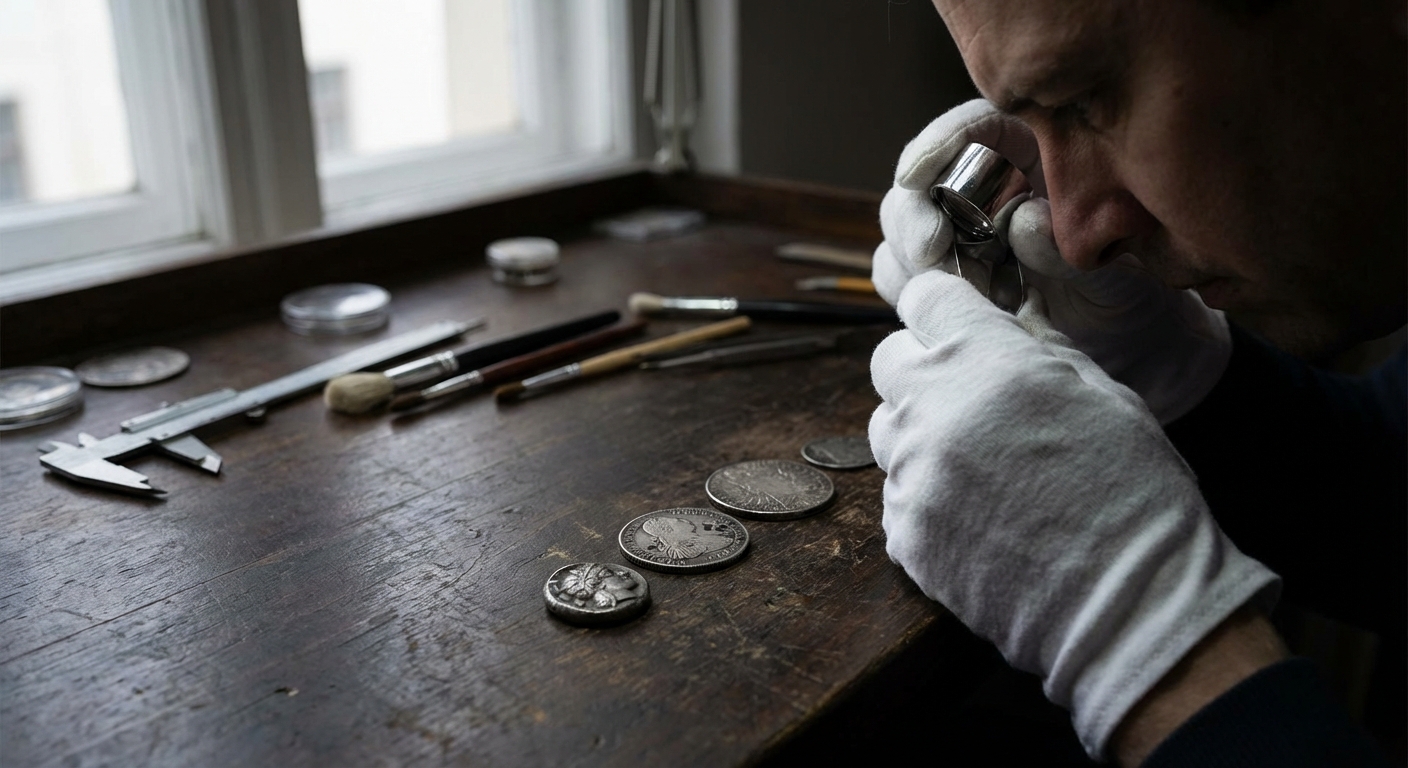
Check the weight standard and module. Measure diameter with calipers and weigh on a 0.01 g scale. Iconic types often spread because their standard was convenient and trusted—imitations frequently cluster around the same weight range but can drift.
-
Inspect edge treatment and anti-fraud features. Look for reeding, lettering, or patterned edges. For trade silver like 8 reales, edge protection mattered because clipping reduced value and trust. (battlefields.org)
-
Compare “design grammar,” not just motifs. Portrait style, legend layout, and emblem placement often copy the prototype even when symbols change. Ask: what parts feel intentionally familiar to merchants?
-
Look for circulation evidence consistent with trade use. Chop marks, test cuts, and heavy wear can be historically meaningful on trade coins. Museum descriptions document chop marks on 8 reales as part of trade verification practices. (americanhistory.si.edu)
-
Separate originals, contemporary imitations, and later restrikes. This is crucial for frozen-date trade types like the Maria Theresa thaler, where many pieces dated 1780 are not 1780 strikes. (theresia.name)
-
Document your reasoning with photos. Take consistent obverse/reverse shots and at least one edge photo. Use diffused lighting and a stable mount; consistency makes later comparison easier when you consult references or forums.
Common Mistakes and How to Avoid Them
-
Mistake: equating “famous design” with “authentic coin.” Iconic types were copied precisely because they were trusted. Treat familiarity as a starting point, not proof. Use weight, edge, and fabric checks before conclusions.
-
Mistake: assuming a frozen date means the strike date. The Maria Theresa thaler is always dated 1780 in later production; collectors can mistakenly pay “original strike” premiums for later restrikes. Use specialist guidance and diagnostics for likely period-of-strike. (en.wikipedia.org)
-
Mistake: ignoring edge details. Edge technology is a major reason some trade coins were preferred, because it discouraged clipping. If you skip the edge, you miss one of the most important “tradition carriers.” (battlefields.org)
-
Mistake: treating chop marks as damage without context. On globally traded silver, chop marks can be part of the coin’s commercial biography. Museum records explicitly note chop marks as verification marks. (americanhistory.si.edu)
-
Mistake: overconfident attribution from one photo. For types with many imitations (e.g., owl tetradrachm family), you often need weight, diameter, edge, and style comparison—plus provenance—before a firm call.
Connection to Online Tools
Online tools can make “influence tracking” practical. Collection inventory apps and spreadsheets let you tag coins by prototype relationships (e.g., “trade dollar family,” “owl imitation,” “denarius-descended penny system”), which is useful when your collection spans eras and regions.
Digital references—museum collection databases, auction archives, and scholarly catalogues—also help you compare style, weight, and edge details across many examples. Use them to build a personal comparison set: save reference images, record measurements, and note diagnostics you can re-check when new coins arrive.
Summary
-
Iconic coin types shaped later minting traditions because trust scales. When merchants trust a standard, other mints copy it to plug into the same economic network.
-
Influence travels via standards and details: weight/module, edge protection, portrait conventions, and repeatable iconography carry forward even when political authorities change.
-
Collectors can use a repeatable method: measure, inspect edges, compare “design grammar,” and verify whether you’re seeing an original, an imitation, or a restrike—especially for famous trade types like the Spanish 8 reales and Maria Theresa thaler. (americanhistory.si.edu)
Frequently Asked Questions (FAQ)
What coin type most influenced the modern dollar?
Many historical sources point to the Spanish 8 reales (Spanish dollar / piece of eight) as a key model; museum documentation notes the American dollar was based upon these coins and that they remained legal tender in the U.S. until 1857. (americanhistory.si.edu)
Why were milled or patterned edges such a big deal in coin history?
Edges made clipping and shaving easier to detect, protecting a coin’s precious-metal value and boosting trust in circulation—one reason trade coins like the Spanish dollar became widely preferred. (battlefields.org)
Are all Maria Theresa thalers dated 1780 actually from 1780?
No. The type is famously dated 1780 even on later production; references explain that after Maria Theresa’s death, the coin has always carried the 1780 date, and specialist guidance warns that many “1780” pieces are later restrikes. (en.wikipedia.org)
What are chop marks on trade silver coins?
Chop marks are stamps applied by merchants or money handlers to verify a coin’s authenticity/metal in trade. Smithsonian collection descriptions note 8 reales with Chinese chop marks used to check that the coin was made of the silver it was supposed to be. (americanhistory.si.edu)
How can I tell if an ancient “owl” coin is an imitation?
Start with measured weight/diameter, then compare style details and flan/strike fabric against published references. Imitations exist in hoard evidence, so assuming “owl design = Athenian official” is risky; build comparisons and verify beyond a single photo. (en.wikipedia.org)
