Understanding how a coin was made is one of the fastest ways to level up in coin collecting. Minting technique influences almost everything you see under magnification: sharpness, edge shape, surface texture, and even which “flaws” are normal versus suspicious.
This article explains three foundational coin minting techniques—striking, casting, and hammered issues—using a collector’s perspective. Whether you collect ancient coins, medieval hammered pieces, or modern machine-struck issues, knowing the manufacturing method helps you evaluate authenticity, interpret wear, and avoid costly mistakes.
This article is for informational purposes only and does not constitute investment advice.
Basics and Definitions
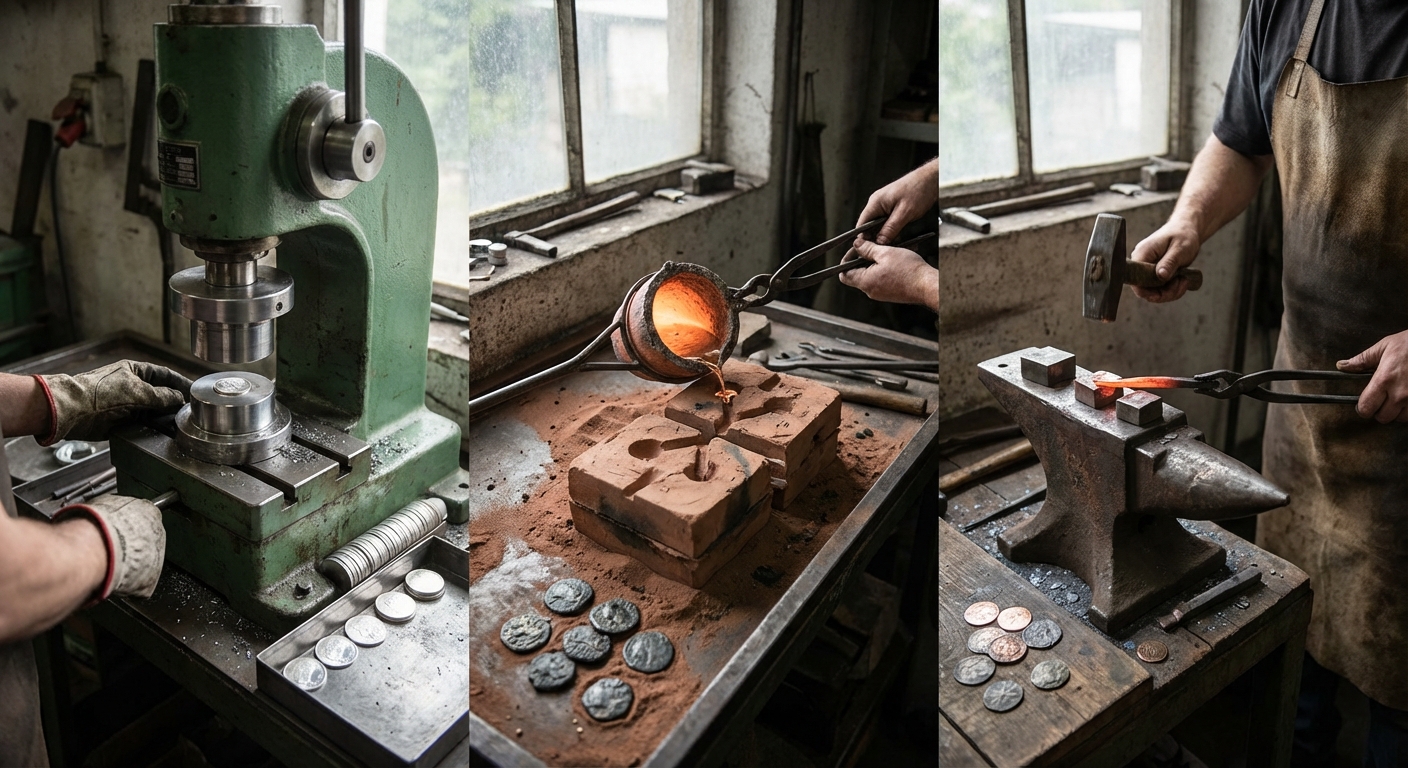
In numismatics, the two primary ways to create a coin are casting and striking. Casting forms a coin by pouring molten metal into a mold, while striking forms a coin by pressing a metal blank between dies so the design is forced into the metal. (numismatics.org)
Hammered coinage is a specific historical form of striking. A blank (often called a planchet or flan) is placed between two dies; the upper die is hit with a hammer to transfer the designs. This method dominated coin production from early coinage into the early modern period, before machine-struck methods took over. (en.wikipedia.org)
Key terms you’ll see in discussions of minting techniques include:
- Planchet / flan: the blank metal disc prepared for striking. (en.wikipedia.org)
- Dies: engraved tools (obverse and reverse) that impress the design when struck or pressed.
- Collar (in modern striking): a ring that confines metal flow during striking; it can form the edge (including reeding). (en.wikipedia.org)
- Sprue: a channel used in casting to deliver molten metal; sprue remnants are trimmed after casting. (numismatics.org)
Detailed Explanation
Each method leaves predictable “manufacturing fingerprints.” Collectors who learn those fingerprints can separate normal minting artifacts from red flags associated with counterfeits or later alterations.
Struck coinage (machine-struck and hand-struck)
Striking creates a coin by compressing a blank between two dies. In modern minting, a collar surrounds the planchet so the metal expands into a controlled shape and the edge can be formed at the same time (such as reeding). (en.wikipedia.org)
Modern industrial striking generally involves carefully prepared planchets (including processes like annealing/softening, cleaning, and edge/rim formation) followed by high-pressure coining presses. These steps improve uniformity and die fill compared with older methods. (britannica.com)
Advantages for collectors: struck coins usually show crisp design transitions, predictable metal flow, and standardized diameters/weights (especially modern issues). Striking also makes it easier to see classic mint errors (off-center strikes, broadstrikes, etc.) when something in the striking system misbehaves. (money.org)
Drawbacks: because struck coins can be extremely consistent, some counterfeits attempt to mimic struck detail by using transfer dies or pressing cast copies—so consistency alone is not proof of authenticity.
Casting (mold-made coins)
Casting forms coins by pouring molten metal into molds. It is mechanically simpler but typically yields less precision in weight and fine detail unless significant labor is applied, and reused molds can produce progressively softer images. (numismatics.org)
In many Western traditions, casting was often used for base-metal coins or very large pieces that were difficult to strike by hand—classic examples include Roman cast bronzes like aes grave. (numismatics.org)
In East Asia, casting was historically a standard production method for long periods; cash coins could be produced in batches from a mold “tree” and then separated, which suits mass output. (en.wikipedia.org)
Collector-visible traits: genuine cast coins may show casting-related surface texture, occasional seam evidence, and characteristics tied to mold technology. However, these same indicators can also appear on cast counterfeits—so context and style matter.
Hammered issues (hand-struck coinage)
Hammered coinage is struck coinage made without a machine press. A planchet is placed between dies and the upper die is struck with a hammer; the lower die is supported on a solid base. (en.wikipedia.org)
What hammered coins often look like: because alignment is manual and force varies, hammered coins are commonly uneven, sometimes off-center, and frequently show irregular flans and variable strike strength. That “handmade” look is normal and is part of their appeal.
Why it matters for authenticity: collectors sometimes reject genuine hammered coins for being “not perfectly round” or “weakly struck,” while simultaneously accepting dangerous fakes that look artificially uniform. Knowing the normal range for a series is crucial.
How technique affects grading, photography, and storage
Grading: on hammered issues, strike weakness and flan problems can mimic wear. On cast coins, softness may be a product of mold wear rather than circulation wear. Technique-aware grading reduces misattributions.
Photography: struck coins often benefit from lighting that emphasizes luster and flow lines; cast coins often photograph best with cross-lighting that reveals surface texture without exaggerating pits.
Storage: technique doesn’t change the basics—stable environment, inert holders, minimal handling—but cast bronzes and ancient hammered silver frequently show porous or fragile surfaces, so avoid abrasive inserts and reduce sliding contact.
Practical Step-by-Step Guide
This practical guide focuses on using minting technique as an authentication and attribution tool—without requiring lab equipment.
-
Identify the expected technique for the type/region/era. For example, many modern circulation coins are machine-struck with collars; many medieval European issues are hammered; some ancient bronzes (like Roman aes grave) are cast. (en.wikipedia.org)
-
Check the edge first. On many cast counterfeits, an edge seam or evidence of sprue removal can be a giveaway. Educational references on cast forgeries emphasize seams, flashing, and cut sprues as common casting artifacts. (calgarycoin.com)
-
Assess design sharpness and “metal flow.” Struck coins often show sharper transitions and compression effects; cast pieces more often show rounded detail and uniform softness when molds have worn. (numismatics.org)
-
Look for strike-related error patterns on modern coins. A collar-related malfunction can create broadstrikes or partial-collar effects; these are striking-system phenomena, not casting traits. (money.org)
-
Compare weight and diameter to reliable references for the series. Casting often varies more, but every series has a known tolerance band; large deviations are a warning sign. For cast Roman aes grave, references describe heavy weight standards and value marks, which you can use as a reality check. (en.wikipedia.org)
-
Use magnification intelligently. Under 5–10×, focus on the edge, high points, and protected recesses. Under higher magnification, avoid over-interpreting micro-pitting on ancient bronzes—patina and corrosion can mimic casting texture.
-
When in doubt, seek a second opinion. For high-value ancient cast bronzes and scarce hammered types, consider established dealers or numismatic experts rather than relying only on photos.
Common Mistakes and How to Avoid Them
-
Mistake: Assuming “seams always mean fake.” Many fakes are cast and show seams, but some genuine cast issues exist (for example, certain Roman cast bronzes). Learn whether the series is supposed to be cast or struck before judging the edge. (numismatics.org)
-
Mistake: Expecting hammered coins to be perfectly round and centered. Irregular flans, uneven strikes, and variable alignment are normal for hammered issues—overly “perfect” examples can be suspicious depending on type and context. (en.wikipedia.org)
-
Mistake: Confusing weak strike with wear (or vice versa). Hammered and early struck coins can be weakly struck in places even when not heavily worn; cast coins can be soft from mold wear. Compare high points and protected areas and look for consistent wear patterns rather than one soft area.
-
Mistake: Overvaluing mint errors without understanding the process. Some errors (like collar-related issues) are rooted in striking mechanics. Learning basic error categories helps you distinguish genuine errors from post-mint damage. (money.org)
-
Mistake: Cleaning coins to “see the method.” Aggressive cleaning can destroy luster on struck coins and strip patina on cast bronzes, removing evidence needed for attribution and authenticity checks. Use proper lighting and magnification instead.
Connection to Online Tools
Online collection tools can make minting-technique knowledge actionable. If your inventory system lets you tag coins as struck, cast, or hammered, you can standardize your photo setup and evaluation checklist by category—especially helpful when you manage mixed-era collections.
Digital “coin cards” (shareable collection pages) are also useful for documenting the evidence behind an attribution: edge photos, weight/diameter, and a short note on why the observed surfaces match struck versus cast manufacturing. Over time, this builds a consistent record you can reference before purchases or trades.
Summary
Striking, casting, and hammered issues are not just manufacturing trivia—they shape a coin’s surfaces, edges, and the kinds of irregularities you should expect. In practical terms, minting technique is a fast filter for authenticity screening and for interpreting what you see when grading.
Use a technique-first workflow: identify the expected method for the series, inspect the edge and surfaces with appropriate lighting, then validate with weight/dimensions and reliable references. For higher-value pieces—especially ancient cast bronzes and scarce hammered coins—consider professional review before committing.
Frequently Asked Questions (FAQ)
How can I tell if a coin is cast or struck?
Start with the edge and surface. Casting often involves sprues and can leave seam evidence if not removed cleanly, while struck coins typically show sharper transitions and compression effects from the dies. (numismatics.org)
Do hammered coins always look off-center or irregular?
Many do. Hammered coinage is produced by placing a planchet between two dies and striking with a hammer, so alignment and force vary, making irregular flans and uneven strikes common. (en.wikipedia.org)
What is a planchet in coin minting?
A planchet (also called a flan) is the prepared blank metal disc that will be struck by the dies. In modern minting, planchets are typically annealed and processed for consistency before striking. (en.wikipedia.org)
What does a coin collar do during striking?
A collar surrounds the planchet during striking, constraining metal flow to shape the coin and often forming edge features like reeding. Collar malfunctions can cause striking errors such as broadstrikes. (en.wikipedia.org)
Are all ancient cast coins counterfeit?
No. Some genuine ancient coin types were cast (notably certain large bronzes), but casting is also widely used for counterfeits. Determining authenticity requires matching the correct technique to the correct series and checking style, fabric, and measurements against references. (numismatics.org)
